Chart Color Schemes
This analysis uses Suburbs and Localities (SAL) boundaries, which can materially differ from Statistical Areas (SA2) even when sharing the same name.
SAL boundaries are defined by Australia Post and the Australian Bureau of Statistics to represent commonly-known suburb names used in postal addresses.
Statistical Areas (SA2) are designed for census data collection and may combine multiple suburbs or use different geographic boundaries. For comprehensive analysis, consider reviewing both boundary types if available.
est. as @ -- *
2021 Census | -- people





Sales Activity


Curious about local property values? Filter the chart to assess the volume and appreciation (including resales) trends and regional comparisons, or scroll to the map below view this information at an individual property level.
Find a Recent Sale

Sales Detail
Population
Population growth drivers in Durack are strong compared to national averages based on AreaSearch's ranking of recent, and medium to long-term trends
Based on analysis of ABS population updates for the broader area, and new addresses validated by AreaSearch since the Census the suburb of Durack (NT)'s population is estimated at around 4,231 as of May 2026. This reflects an increase of 501 people (13.4%) since the 2021 Census, which reported a population of 3,730 people. The change is inferred from the resident population of 4,231, estimated by AreaSearch following examination of the latest ERP data release by the ABS (June 2025) and an additional 1 validated new addresses since the Census date. This level of population equates to a density ratio of 1,439 persons per square kilometer, which is above the average seen across national locations assessed by AreaSearch. Durack (NT)'s 13.4% growth since the 2021 census exceeded the national average (9.3%), marking it as a growth leader in the region. Population growth for the area was primarily driven by natural growth that contributed approximately 64.0% of overall population gains during recent periods.
For each SA2 area, AreaSearch utilizes projections from ABS and Geoscience Australia published in 2024 using 2022 as the baseline. Where these projections are unavailable, and to calculate development beyond 2032, growth dynamics by age group from the ABS Greater Capital Region forecasts (released in 2023, utilizing 2022 data) are applied. Anticipating these changing demographic trends, the suburb of Durack (NT) is set to experience population gains exceeding the national median, climbing by 660 persons by 2041 according to combined SA2 projections, representing a 15.6% overall expansion over the 16 years.
Frequently Asked Questions - Population
Development
Recent residential development output has been above average within Durack when compared nationally
AreaSearch's evaluation of ABS building approval statistics compiled from local area datasets indicates that Durack has averaged approximately 9 new home approvals annually. This includes an estimated 47 residential approvals over the 5 financial years spanning FY-21 to FY-25, alongside 27 approvals so far during FY-26. Given that an average of 6.3 people moved to the area annually for every completed residence during the 5 financial years from FY-21 to FY-25, residential supply is lagging behind demand significantly, driving up purchasing competition and property prices, with new homes constructed at an average estimated cost of $369,000. Furthermore, $41,000 in commercial building permits were recorded this financial year, pointing to a heavily residential development environment.
In comparison to Greater Darwin, Durack generates roughly 58% of the residential building volume per resident, placing it in the 54th percentile of all regions analyzed across Australia, even though construction activity has accelerated recently. This volume falls below the national benchmark, highlighting the suburb's established state and suggesting potential planning restrictions. Recent building permits show a mix of 33.0% detached houses and 67.0% multi-unit dwellings. Focusing on medium to high-density layouts provides more affordable purchasing options and caters well to downsizers, property investors, and first-time buyers. This represents a distinct departure from the local established property mix, which currently consists of 95.0% houses, showing a shrinking supply of vacant buildable land alongside evolving lifestyle choices and a call for varied, low-cost living arrangements. With approximately 296 residents for every approved dwelling permit, Durack demonstrates an evolving property market.
Long-term forecasts suggest Durack will add 660 residents by 2041, according to the most recent quarterly estimate by AreaSearch. If current building rates persist, residential supply may struggle to keep pace with this influx, which could escalate competition among buyers and support upward price pressure.
Frequently Asked Questions - Development
Development applications around Durack (NT)
Loading development applications…
| Lodged | Address | Description | Type | Distance | Status |
|---|
SOURCE: Planning portals and council registers, compiled by AreaSearch. Distance & bearing measured from the suburb midpoint.
Infrastructure
Durack has limited levels of nearby infrastructure activity, ranking in the 14thth percentile nationally
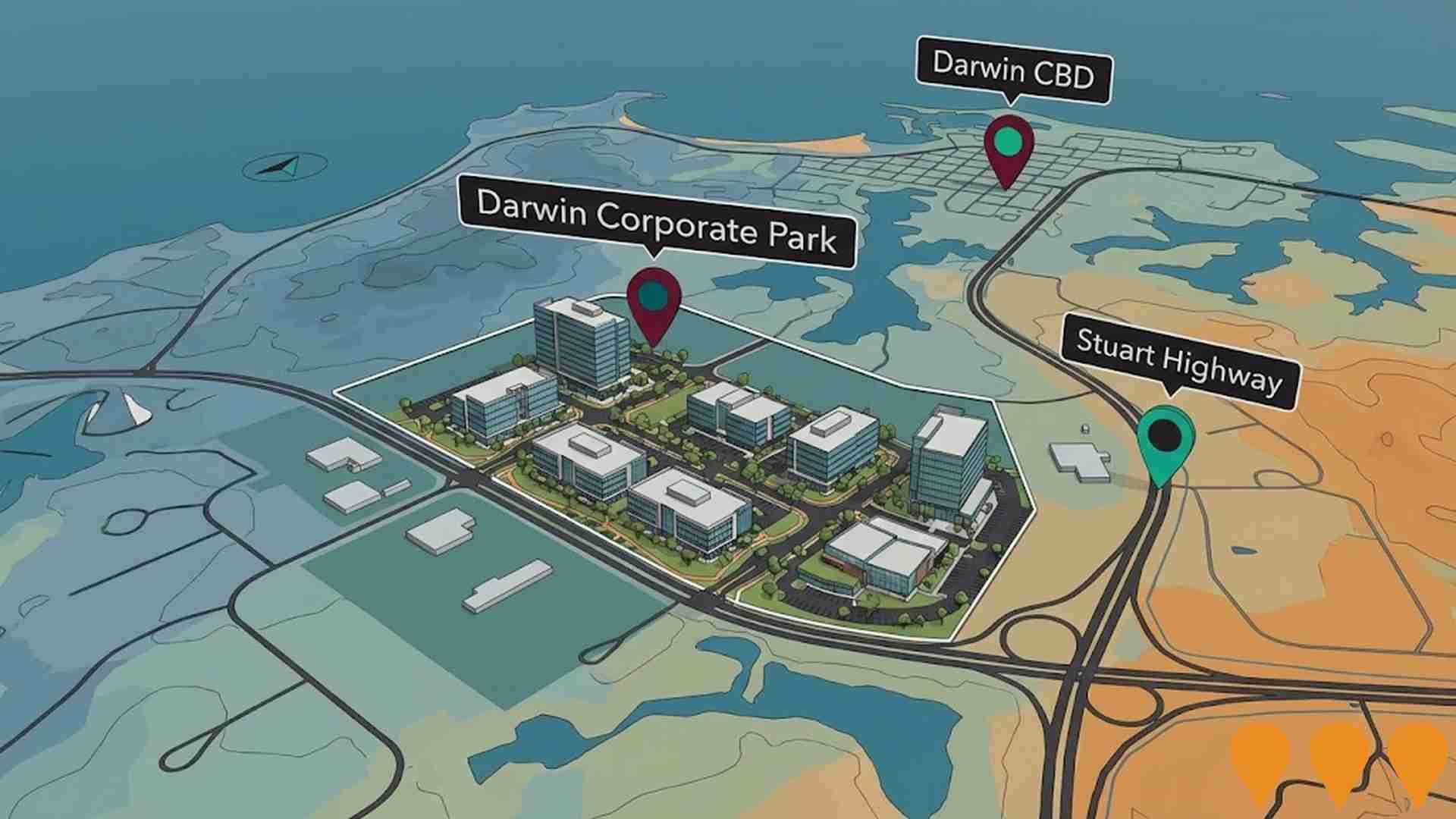
Local infrastructure projects, major planning decisions, and new developments have a significant impact on suburb performance. AreaSearch has identified no projects likely to influence this location. Notable projects in the wider region include the Darwin to Palmerston Mass Transit Corridor, Hudson Creek Power Station, Marine Industry Park, and Darwin Corporate Park, with the detailed list showing the most relevant items.
Professional plan users can use the search below to filter and access additional projects.
INFRASTRUCTURE SEARCH
 Denotes AI-based impression for illustrative purposes only, not to be taken as definitive under any circumstances. Please follow links and conduct other investigations from the project's source for actual imagery. Developers and project owners wishing us to use original imagery please Contact Us and we will do so.
Frequently Asked Questions - Infrastructure
Enabling Digital Health Services for Regional and Remote Australia
A national digital infrastructure program under the Digital Health Blueprint 2023-2033 designed to provide equitable healthcare access for regional and remote Australians. The initiative is currently rolling out the 'Share by Default' legislative framework, which mandates the uploading of pathology and diagnostic imaging reports to My Health Record starting July 2026. Current 2026 milestones include the launch of the Digital Health Implementer Hub to accelerate software conformance and the implementation of the National Allied Health Digital Uplift Plan to integrate allied health practitioners into the national digital ecosystem.

Australia-Asia PowerLink (AAPowerLink)
SunCable's AAPowerLink is a large renewable generation, battery storage and HVDC transmission project in the Northern Territory. The project has major environmental approvals from the Northern Territory and Australian governments, conditional Singapore approval to import 1.75 GW from 2035, Indonesian subsea permits, a Singapore-Australia cross-border electricity trade framework and a 70-year Indigenous Land Use Agreement for Powell Creek. It is being staged to supply industrial customers in the Barkly region from the late 2020s, Darwin from the early 2030s, and Southeast Asia from the mid-2030s, with final investment decision targeted for 2027.

Darwin to Palmerston Mass Transit Corridor
A long-term strategic concept to reserve a rapid transit corridor between Darwin CBD and Palmerston, broadly along the Stuart Highway. The Darwin Regional Transport Plan 2018 identifies the potential for future bus rapid transit or light rail along established public transport routes as the region grows toward a longer term population of 250,000. There is no funded project, no business case, and no formal Stage 1 scope. The concept has been raised periodically in public debate (2014, 2017, 2020) but has not progressed beyond corridor preservation consideration. Current NT Government public transport activity is focused on bus network reform rather than rail. The notional valuation here is indicative only and based on comparable Australian light rail builds.

Desert Springs Octopus Renewable Energy Program
Majority Indigenous-owned developer pursuing a near-term pipeline of grid-connected solar and battery projects along the Darwin-Katherine Electricity System, with potential to expand into wind and green hydrogen. Partnership includes Octopus Australia with Larrakia Nation and Jawoyn Association to deliver utility-scale renewable energy and community benefit sharing.

National EV Charging Network (Highway Fast Charging)
Partnership between the Australian Government and NRMA to deliver a backbone EV fast charging network on national highways. Program funds and co-funds 117 DC fast charging sites at roughly 150 km intervals to connect all capital cities and regional routes, reducing range anxiety and supporting EV uptake.

Hudson Creek Power Station
12MW natural gas-fired power plant, NT's first privately owned grid-connected gas generation facility. Features 25% lower emissions than average NT gas generators. Part of dual project with Batchelor Solar Farm, creating 162 construction jobs and providing vital grid stability to Darwin-Katherine network.

Marine Industry Park
Marine and offshore industries servicing hub at East Arm, Darwin. Stage 1 planning approval is secured for a purpose-built industrial subdivision near the new Darwin Ship Lift, with expressions of interest open for serviced lots. Existing common-user facilities include an all-tide barge ramp (first point of entry) and a secure hardstand supporting storage and fabrication activities.

Network Optimisation Program - Roads
A national program concept focused on improving congestion and reliability on urban road networks by using low-cost operational measures and technology (e.g., signal timing, intersection treatments, incident management) to optimise existing capacity across major city corridors.

Employment
AreaSearch analysis of employment trends sees Durack performing better than 90% of local markets assessed across Australia
Durack has a skilled workforce, with essential services sectors well represented, an unemployment rate of just 1.6%, and 0.7% in estimated employment growth over the past year, based on AreaSearch aggregation of statistical area data. As of March 2026, 2,514 residents are in work while the unemployment rate is 1.8% below Greater Darwin's rate of 3.5%, and workforce participation is well beyond standard (78.7% compared to Greater Darwin's 72.7%). Based on Census responses, a low 4.4% of residents were found to work from home, though Covid-19 lockdown impacts should be considered.
The primary employment sectors for local citizens are public administration & safety, health care & social assistance, and construction. Conversely, health care & social assistance is under-represented, with only 11.2% of Durack's workforce compared to 14.2% in Greater Darwin. The predominantly residential area appears to offer limited employment opportunities locally, as indicated by the count of Census working population vs resident population.
Based on AreaSearch analysis of SALM and ABS data, aggregated from broader statistical areas, the 12-month period saw employment increasing by 0.7% alongside labour force increasing by 0.9%, causing the unemployment rate to rise by 0.2 percentage points. In contrast, Greater Darwin experienced employment growth of 0.4% and labour force growth of 0.8%, with a 0.3 percentage point rise. Jobs and Skills Australia's national employment forecasts from May-25 can offer further insight into potential future demand within Durack. These projections, covering five and ten-year periods, have been mapped against the local employment profile to estimate growth patterns. While national employment is forecast to expand by 6.6% over five years and 13.7% over ten years, growth rates differ significantly between industry sectors. Applying these industry-specific projections to Durack's employment mix suggests local employment should increase by 6.1% over five years and 12.7% over ten years (please note this is a simple weighting extrapolation for illustrative purposes and does not take into account localised population projections).
Frequently Asked Questions - Employment
Income
Income metrics indicate excellent economic conditions, with the area achieving higher performance than 75% of national locations assessed by AreaSearch
The suburb of Durack shows a median taxpayer income of $63,030 and an average of $69,591 according to the latest postcode level ATO data aggregated by AreaSearch for financial year 2023. This is just above the national average, contrasting with Greater Darwin's median income of $66,956 and average income of $77,199. Based on Wage Price Index growth of 9.41% since financial year 2023, current estimates would be approximately $68,961 (median) and $76,140 (average) as of March 2026. From the 2021 Census, household, family and personal incomes all rank highly in Durack, between the 90th and 94th percentiles nationally. Income analysis reveals the $1,500 - 2,999 earnings band captures 44.2% of the community (1,870 individuals), mirroring regional levels where 36.7% occupy this bracket. The locality demonstrates considerable affluence with 36.2% earning over $3,000 per week, supporting premium retail and service offerings. High housing costs consume 17.9% of income, though strong earnings still place disposable income at the 87th percentile and the area's SEIFA income ranking places it in the 7th decile.
Frequently Asked Questions - Income
Housing
Durack is characterized by a predominantly suburban housing profile, with a higher proportion of rental properties than the broader region
Residential structures in Durack at the time of the latest Census consisted of 95.4% separate houses and 4.6% alternative housing styles including semi-detached, townhouses, and units, which contrasts with metropolitan Darwin where houses represent 63.5% and alternative dwellings account for 36.5%. Homeowners without debt represented 11.4% of the local property market, meaning the remaining properties were held under a mortgage (42.5%) or occupied by tenants (46.1%). Monthly mortgage costs in the suburb stood at a median of $2,167, while weekly rental payments sat at a median of $500, compared to metro averages of $2,100 and $385 respectively. On a national level, mortgage commitments in Durack are higher than the Australian median of $1,863, and weekly rents exceed the national benchmark of $375.
Frequently Asked Questions - Housing
Household Composition
Durack features high concentrations of family households and group households, with a higher-than-average median household size
Families make up the vast majority of local households at 80.8%, consisting of couples raising children at 40.6%, couples without children at 28.2%, and single-parent homes at 10.9%. Single person homes and shared houses constitute the remaining 19.2%, with lone occupants making up 15.3% and group arrangements at 4.2%. The median occupancy stands at 2.8 people per house, which is larger than the Greater Darwin average of 2.6.
Frequently Asked Questions - Households
Local Schools & Education
The educational profile of Durack exceeds national averages, with above-average qualification levels and academic performance metrics
Compared to the broader territory, this suburb presents a highly academic profile, with tertiary qualification rates sitting at 26.7% of citizens aged 15+ which is higher than the SA3 regional average of 21.4%. Bachelor degrees are the most common credential at 17.5%, followed by postgraduate degrees at 6.0% and graduate diplomas at 3.2%. Practical and vocational qualifications are also strongly represented, with 41.1% of residents aged 15+ holding trade credentials, consisting of advanced diplomas at 12.6% and certificate qualifications at 28.5%.
A significant proportion of the population is engaged in study, with 33.0% of local citizens currently enrolled in educational programs. Of these students, 12.2% attend primary schools, 7.3% are in secondary institutions, and 5.6% are enrolled in tertiary education.
Frequently Asked Questions - Education
Schools Detail
Nearby Services & Amenities
Transport
Transport servicing is moderate compared to other areas nationally based on assessment of service frequency, route connectivity and accessibility
Analyses of local public transport show 14 active stops operating in Durack, utilizing a network of buses. These stops are serviced by 27 separate routes, providing 1,362 passenger trips each week. Transport connectivity is high, with properties located an average of 220 meters from the nearest stop. Because this is a residential suburb, most people travel outside the area for work, and driving remains the primary method at 93%. Households own an average of 1.7 cars, which is above the regional average. A small portion of residents, representing 4.4%, worked from home during the 2021 Census, which may have been influenced by COVID-19 rules.
Across all transit routes, service frequency averages 194 trips daily, which equates to about 97 weekly journeys for each individual stop.
Frequently Asked Questions - Transport
Transport Stops Detail
Health
The level of general health in Durack is notably higher than the national average with both young and old age cohorts seeing low prevalence of common health conditions
Assessments by AreaSearch regarding death rates and ongoing illnesses show that Durack has positive health outcomes, with young and elderly groups experiencing low rates of common health conditions, and private healthcare insurance held by roughly 54% of the population, which equals approximately 2,297 people. This compares to 57.8% throughout Greater Darwin.
Asthma and mental health conditions were the most frequently reported diagnoses in the suburb, affecting 6.8% and 6.4% of the population respectively, whereas 78.4% of citizens reported no chronic illnesses at all, compared to 77.1% for Greater Darwin. The working-age population is healthy, with minimal instances of chronic illnesses. Citizens aged 65 and over make up 9.0% of the population, representing 380 people, which is lower than the Greater Darwin figure of 11.0%. Seniors in this suburb show strong health profiles, with national rankings that exceed those of the overall local population.
Frequently Asked Questions - Health
Cultural Diversity
The level of cultural diversity witnessed in Durack was found to be above average when compared nationally for a number of language and cultural background related metrics
Durack has a higher level of cultural diversity than most regional areas, with 27.0% of citizens born outside of Australia and 19.9% of households using a language other than English. Christianity is the dominant religion, practiced by 44.1% of the population. However, the most distinct religious difference is the presence of Hinduism at 3.0% of the population, compared to 4.2% across Greater Darwin.
Regarding parent birthplaces, the largest heritage groups in Durack are Australian at 25.6%, English at 22.8%, and Other at 10.1%. There are also differences in specific backgrounds: Filipinos represent 4.6% of the suburb, compared to 3.8% across the region, while Maori residents account for 1.0% compared to 0.6% regionally, and Sri Lankans make up 0.5% compared to 0.3% regionally.
Frequently Asked Questions - Diversity
Age
Durack hosts a very young demographic, ranking in the bottom 10% of areas nationwide
The suburb of Durack (NT) has a median age of 32, making it younger than Greater Darwin at 34 and younger than the Australian median of 38. Compared to Greater Darwin, the suburb has a larger proportion of toddlers aged 0 - 4 at 9.1%, but a smaller share of youths aged 15 - 24 at 10.4%. Since 2021, the 55 to 64 age category grew from 8.5% to 10.2% of the population, and the 65 to 74 group rose from 4.6% to 6.2%. In contrast, the 25 to 34 age bracket fell from 19.7% to 18.1%, and the 45 to 54 cohort decreased from 12.1% to 10.7%. Looking forward to 2041, population models suggest shifts in the age profile, with the 65 to 74 age group set to increase by 143 people (55%) from 262 to 406, while the 0 to 4 group is forecast to grow by 2%, adding 7 children.