Chart Color Schemes
This analysis uses ABS Statistical Areas Level 2 (SA2) boundaries, which can materially differ from Suburbs and Localities (SAL) even when sharing similar names.
SA2 boundaries are defined by the Australian Bureau of Statistics and are designed to represent communities for statistical reporting (e.g., census and ERP).
Suburbs and Localities (SAL) represent commonly-used suburb/locality names (postal-style areas) and may use different geographic boundaries. For comprehensive analysis, consider reviewing both boundary types if available.
est. as @ -- *
ABS ERP | -- people | --
2021 Census | -- people







Curious about local property values? Filter the chart to assess the volume and appreciation (including resales) trends and regional comparisons, or scroll to the map below view this information at an individual property level.


Find a Recent Sale

Sales Detail
Penola has an estimated 3,196 residents, up from 3,107 at the 2021 Census — a change of 89 people, or 2.9%. Fewer than ten people live on each square kilometre, across a boundary that takes in surrounding rural land. Population is estimated from ABS Estimated Resident Population releases and GNAF address data, re-based from the 2021 Census and updated annually.
Detail
According to research conducted by AreaSearch, the resident count in Penola stands at approximately 3,196 as of Aug 2026. Compared to the 3,107 individuals recorded in the 2021 Census, this indicates an expansion of 89 people (2.9%). This demographic adjustment is calculated using the June 2025 ABS estimated resident population figure of 3,192 combined with 25 validated new addresses documented post-Census. With this population level, the community registers a density of 2.1 persons per square kilometer, ensuring spacious residential conditions. Tracking within 2.2 percentage points of the broader SA3 area (5.1%), Penola's 2.9% post-Census increase underscores resilient demographic drivers.
Natural increase served as the primary contributor to local expansion, generating roughly 50.0% of the overall population additions in recent times. Projections compiled by the ABS and Geoscience Australia, published in 2024 using 2022 baseline figures, are utilised by AreaSearch for SA2 territories. Where SA2 coverage is absent, or for periods extending beyond post-2032, figures from the SA State Government's 2023 Regional/LGA age-cohort releases (grounded in 2021 data) are integrated via a weighted aggregation framework converting LGA figures to SA2 boundaries. Anticipated demographic patterns point toward growth aligned with the lower quartile of non-metropolitan districts, with the latest annual ERP baseline suggesting Penola will add 74 persons by 2041, representing a cumulative rise of 2.2% across the 16 years.
Frequently Asked Questions - Population
30 new dwellings have been approved in Penola over the past five years, an average of 6 a year. That is 1.9 approvals per 1,000 residents. Figures come from ABS building approvals aggregated to this SA2 boundary and are updated monthly as the ABS releases them.
Detail
Residential building authorisations in Penola have proceeded at a pace of roughly 6 new dwellings per annum, amounting to 30 homes throughout the preceding 5 financial years. With an influx averaging 1.4 new residents annually per built dwelling between FY-22 and FY-26 across the past 5 financial years, market equilibrium is well sustained and supports steady property dynamics, while approved dwellings carry an average construction value of $394,000. Meanwhile, commercial planning authorisations stand at $5.4 million within this financial year, reflecting modest activity in the commercial development segment. Relative to Rest of SA, Penola demonstrates substantially subdued construction volumes (59.0% below regional average per person).
This lower rate of new residential builds frequently sustains pricing levels and buyer interest across existing properties. Activity also trails nationwide figures, highlighting established local dynamics alongside potential limitations on development. Furthermore, new building activity has consisted entirely of standalone homes, preserving the locality's low-density profile and prioritising family residences that cater to buyers seeking space. An estimated ratio of 532 people per dwelling approval across the region further illustrates this subdued building climate. According to the most recent AreaSearch quarterly projections, Penola is anticipated to expand by 70 residents by 2041. Under current construction trajectories, incoming residential developments should easily satisfy local housing demand, fostering advantageous conditions for purchasers and potentially facilitating expansion beyond current demographic projections.
Frequently Asked Questions - Development
Development applications around Penola
Loading development applications…
| Lodged | Address | Description | Type | Distance | Status |
|---|
SOURCE: Planning portals and council registers, compiled by AreaSearch. Distance & bearing measured from the suburb midpoint.
AreaSearch tracks 69 current infrastructure and development projects close to Penola, worth an estimated $15.7 billion. 12 are already under construction and 24 are due for completion within three years. The pipeline spans transport & logistics, energy and communities, precincts & urban renewal. Records are compiled from Infrastructure Australia, state agencies, council planning portals and public announcements, reviewed and updated daily, then ranked by proximity, construction stage, completion horizon and project scale.
Detail
Strategic planning policies, major civil works, and infrastructure upgrades exert a decisive impact on local performance. In total 1 a single project has been identified by AreaSearch that is likely to have an impact on the area. Notable developments include the Lower Limestone Coast Water Allocation Plan, Limestone Coast Energy Park, Wattle Range Council General Code Amendment, and Melbourne To Adelaide Freight Rail Improvements, with the primary initiatives outlined below.
Professional plan users can use the search below to filter and access additional projects.
INFRASTRUCTURE SEARCH
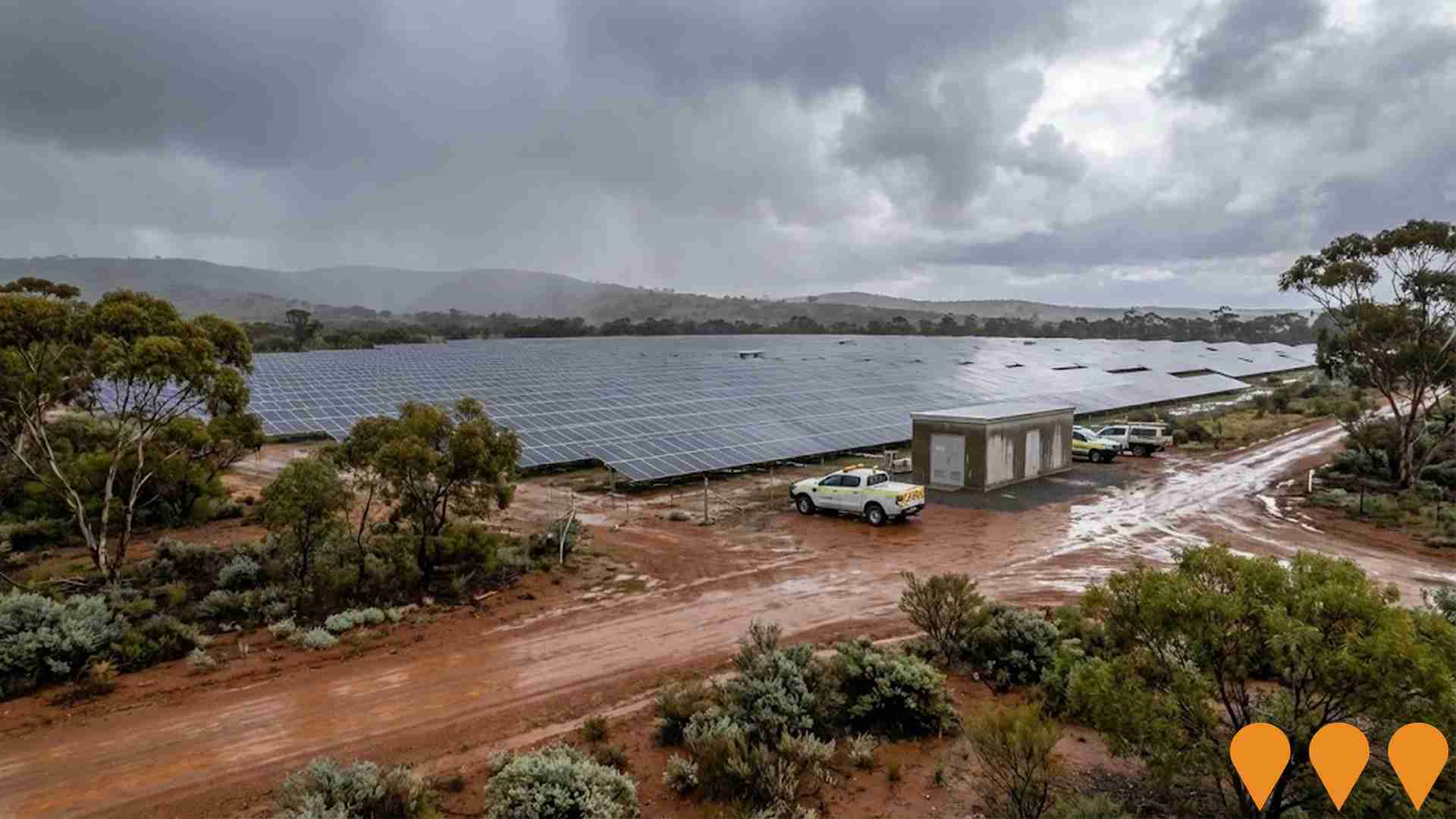
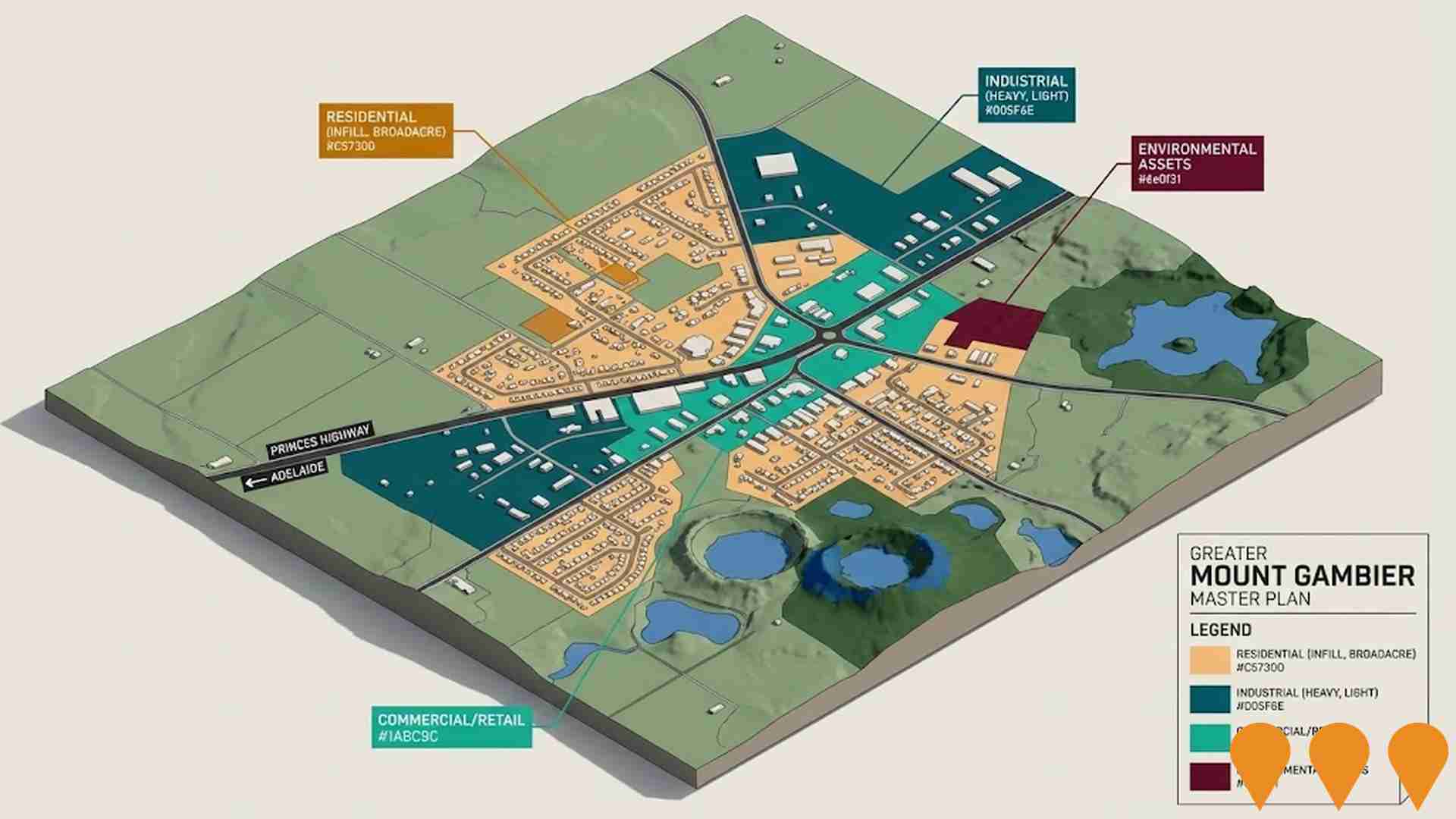
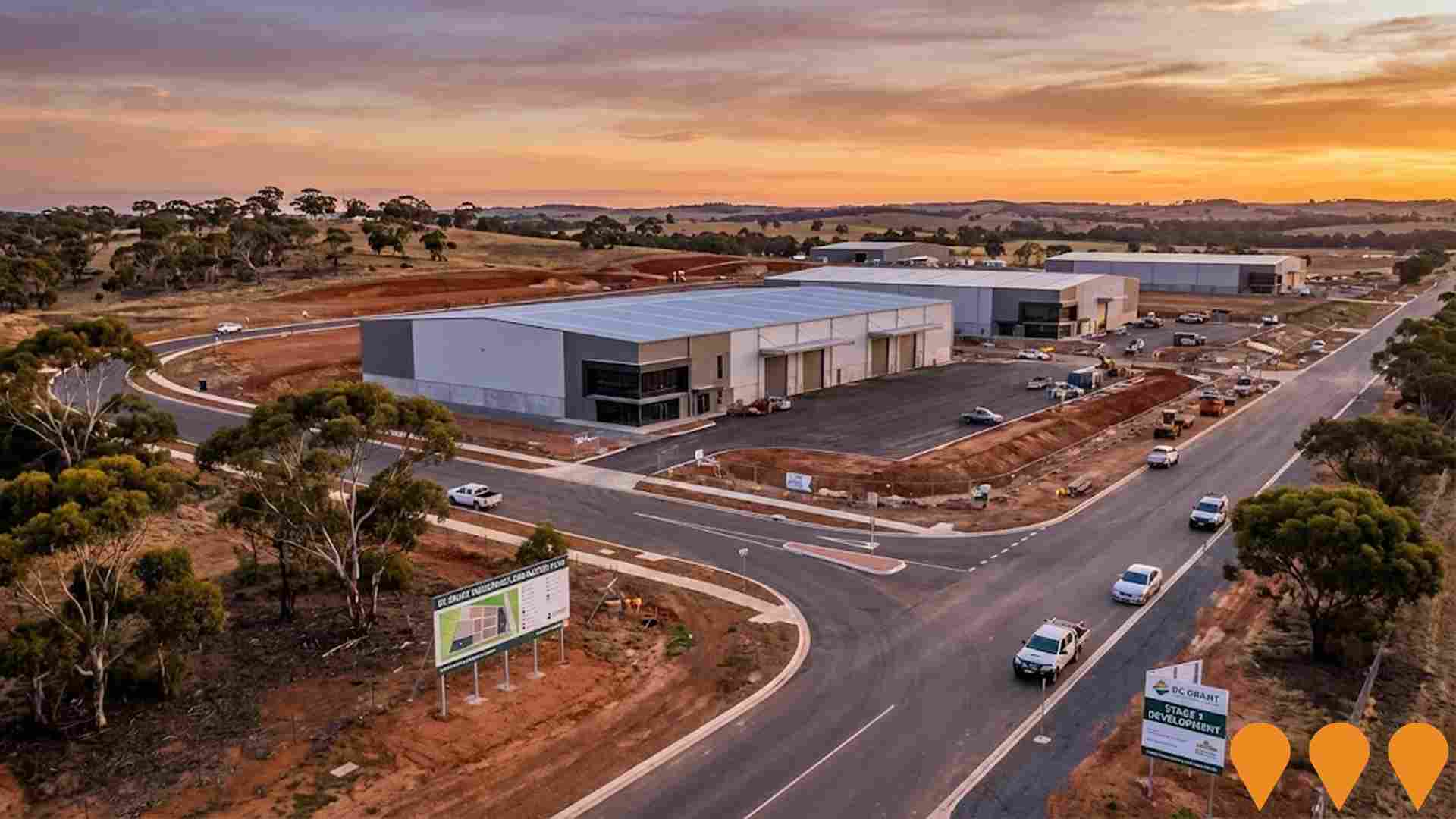
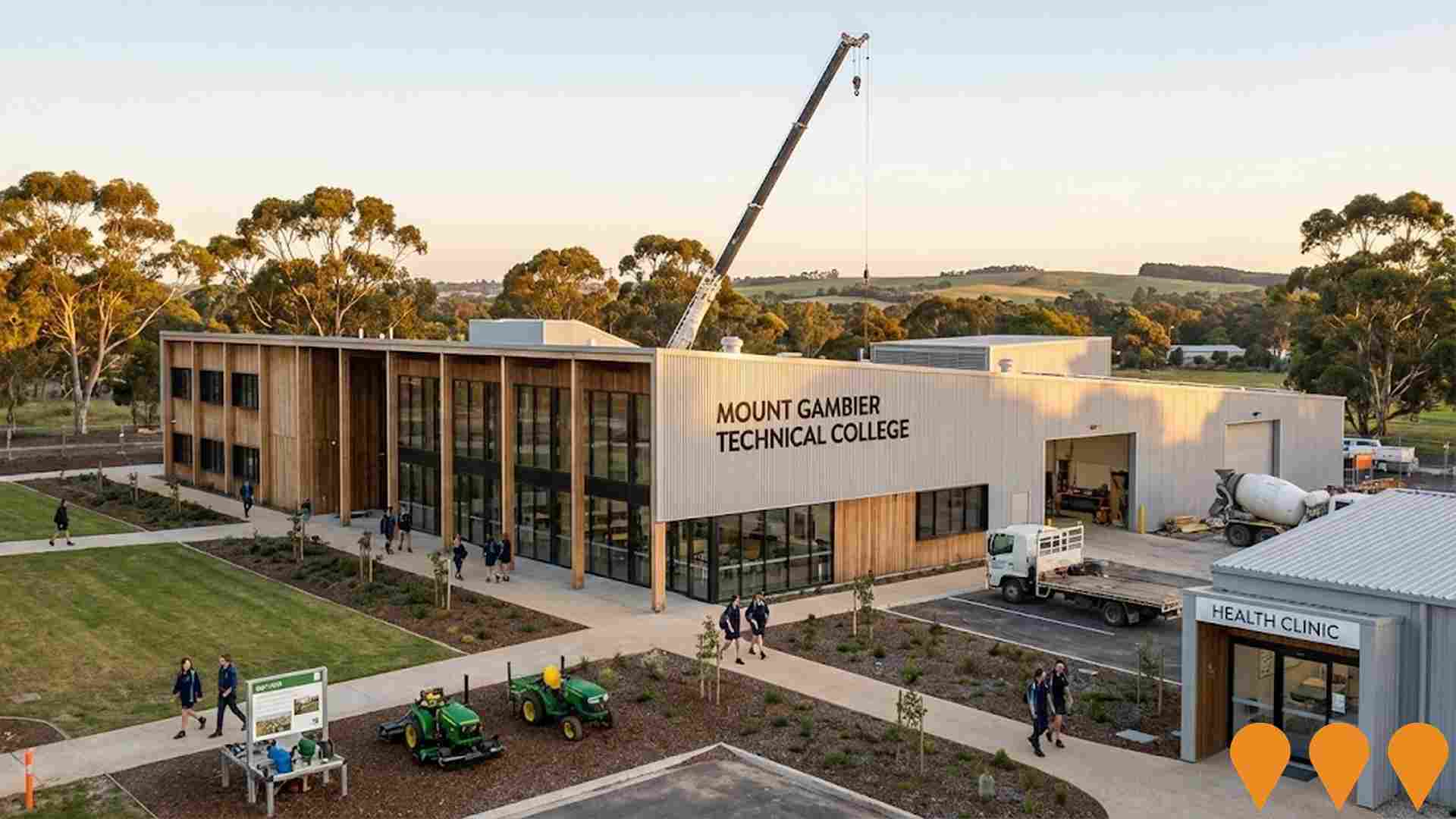
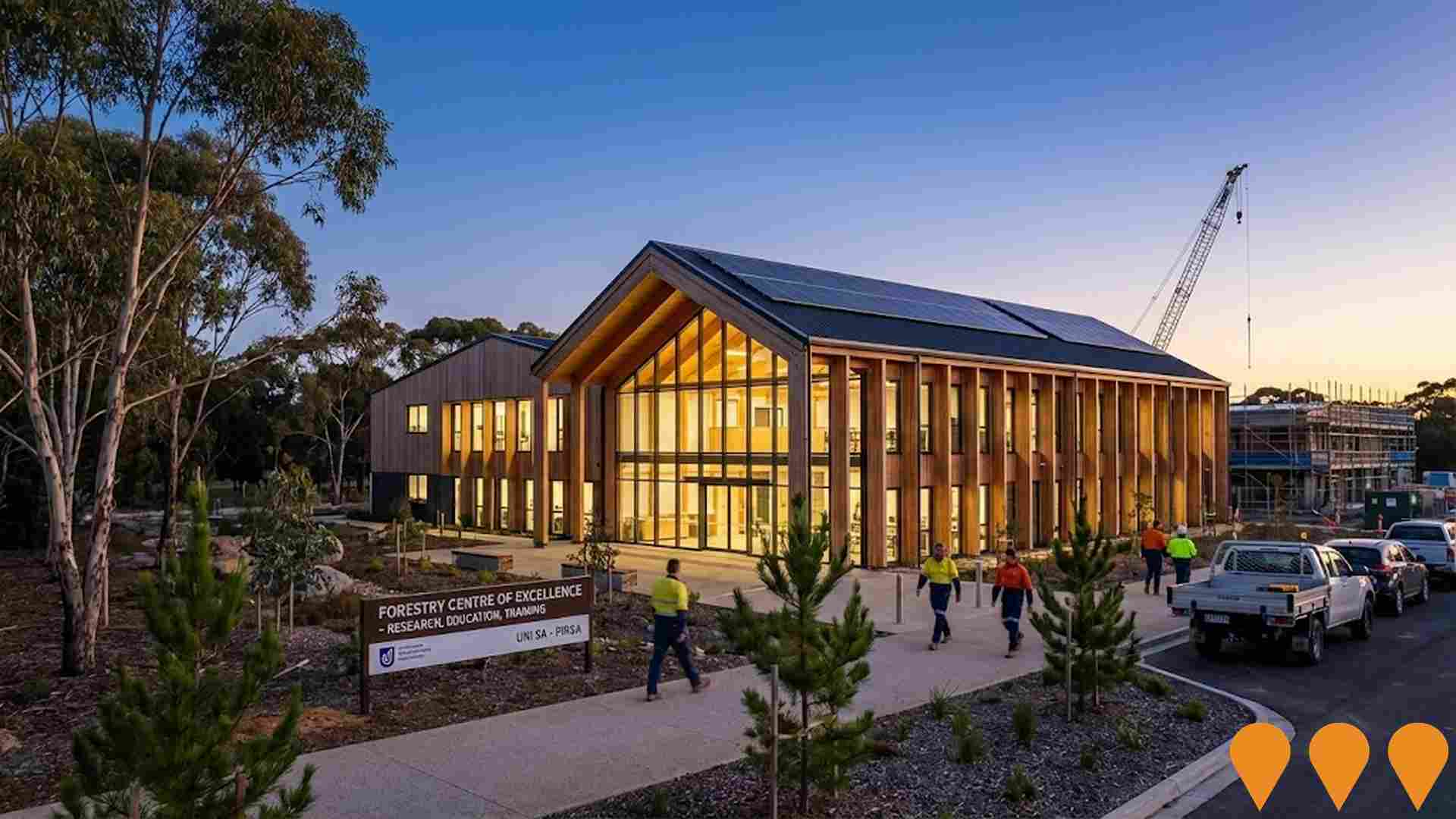
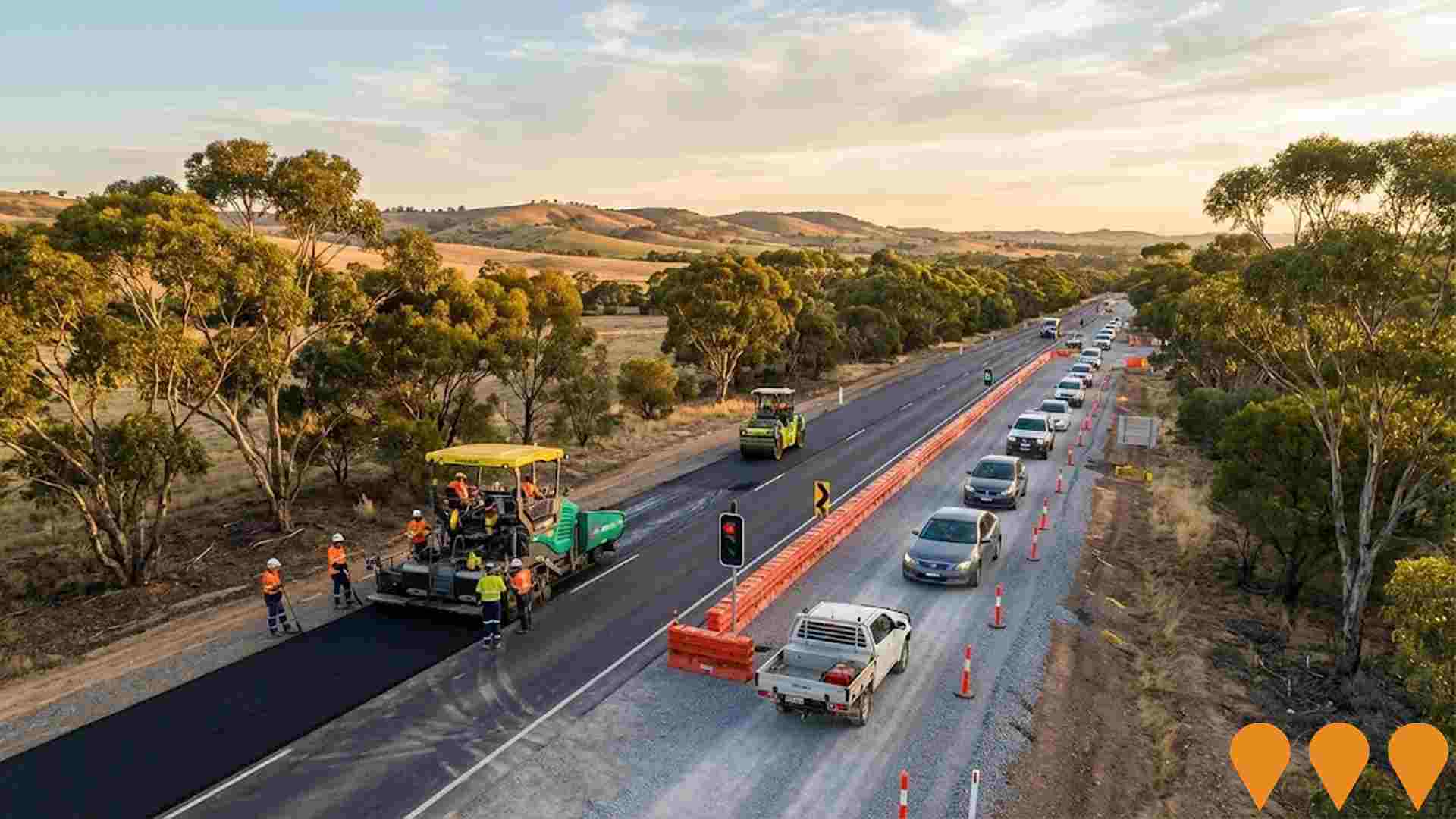
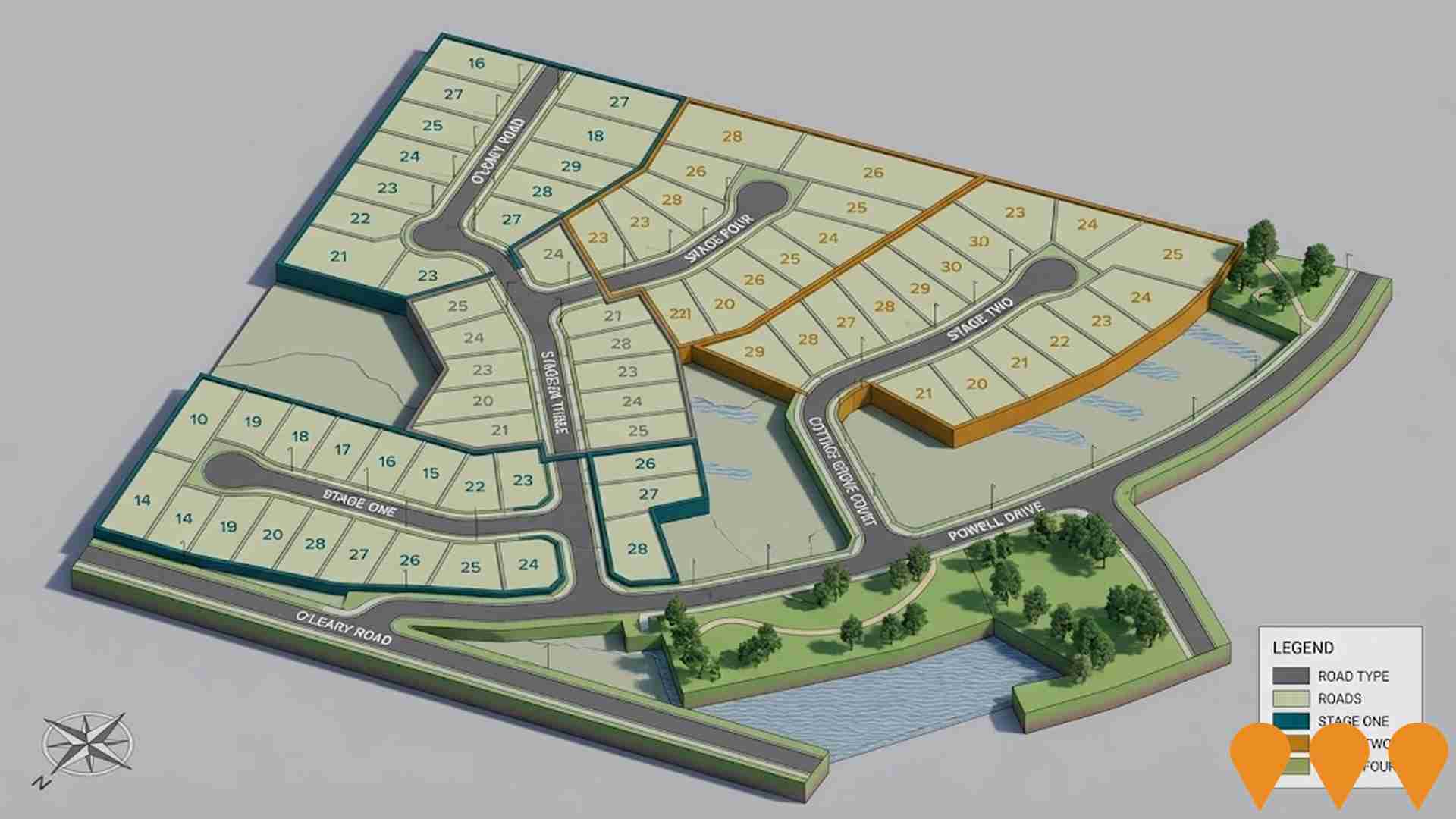
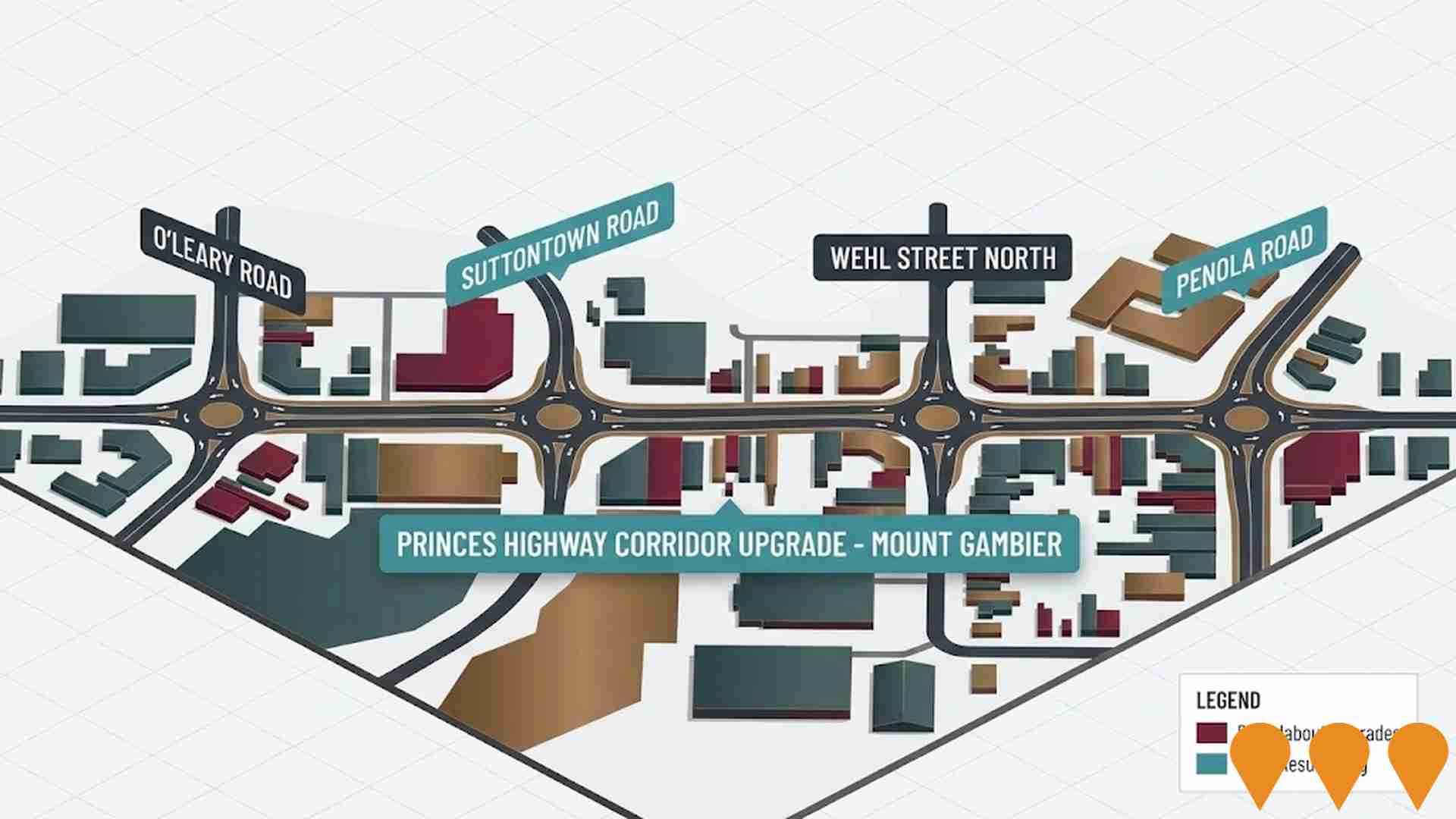
 Denotes AI-based impression for illustrative purposes only, not to be taken as definitive under any circumstances. Please follow links and conduct other investigations from the project's source for actual imagery. Developers and project owners wishing us to use original imagery please Contact Us and we will do so.
Frequently Asked Questions - Infrastructure
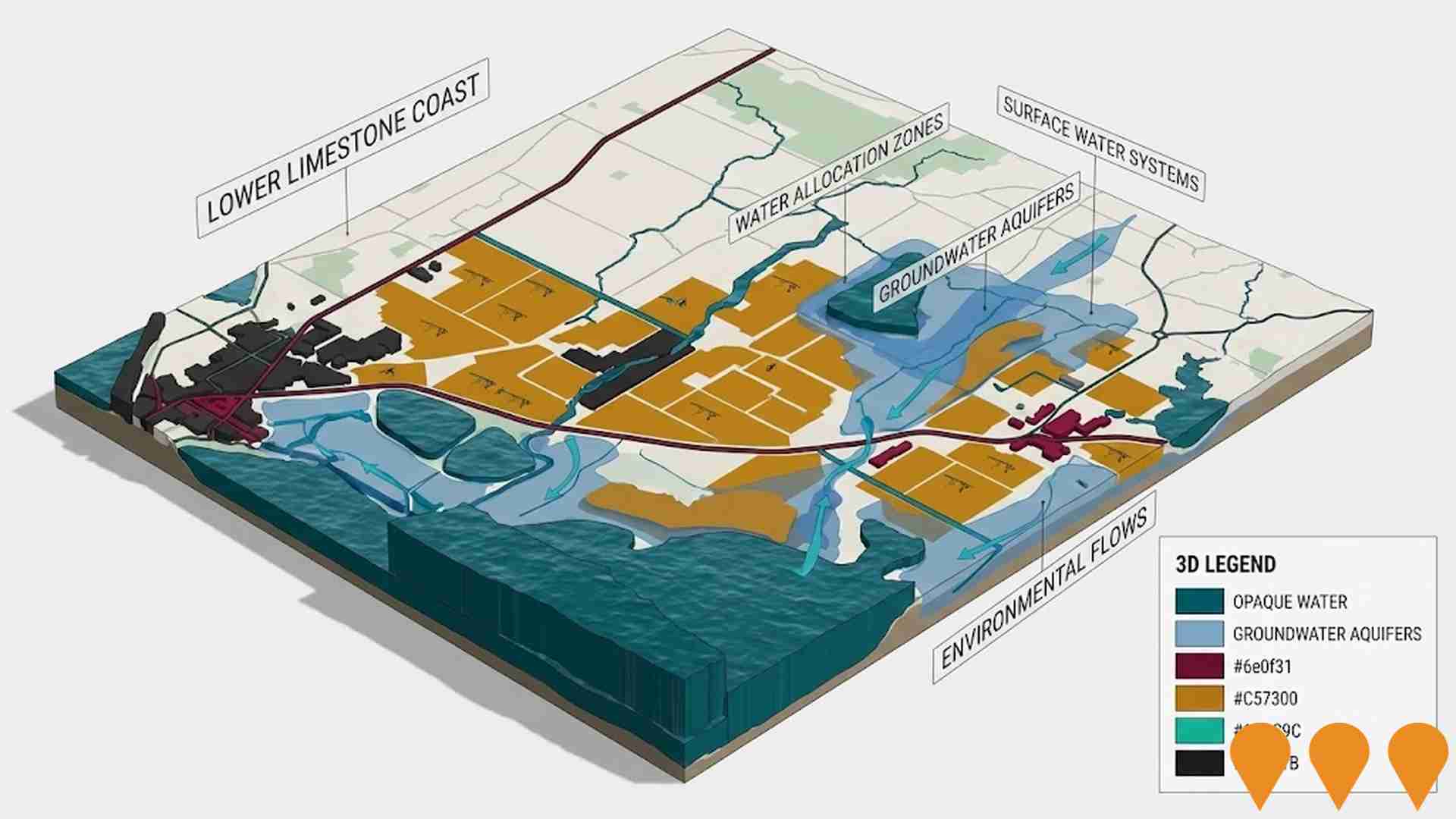
Lower Limestone Coast Water Allocation Plan
A water allocation plan setting rules for groundwater management in the Lower Limestone Coast, ensuring long-term sustainability and security of the water resource for environmental, social, cultural, and economic needs.
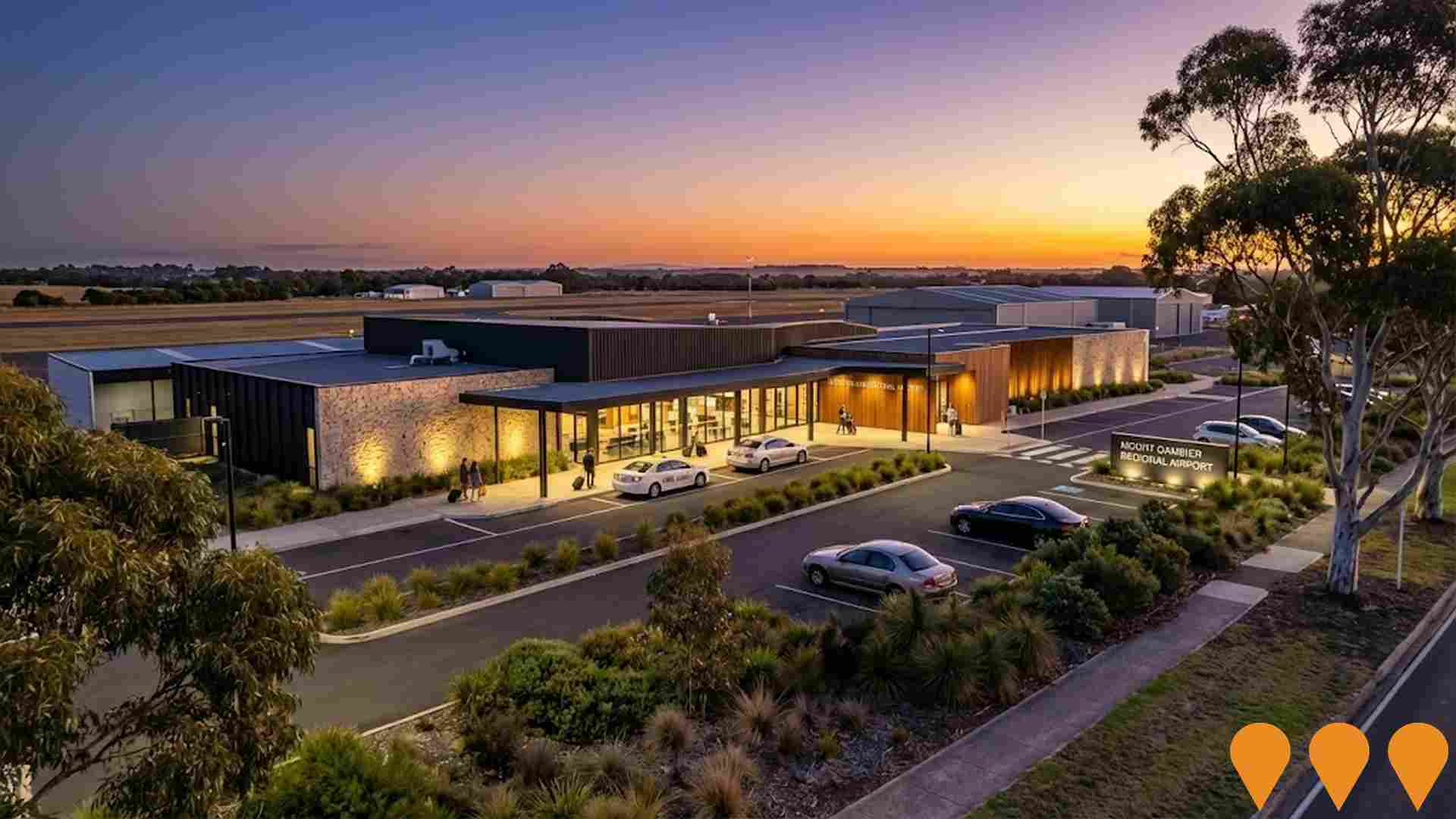
Mount Gambier Regional Airport Master Plan 2025-2035
Endorsed District Council of Grant master plan guiding Mount Gambier Regional Airport improvements from 2025 to 2035. Short-term actions include a small playground, renewable energy systems, carpark extension and an investment prospectus. Longer-term actions include runway extensions and resurfacing, an onsite commercial precinct and public toilet refurbishment, with advocacy for a flying school, airport history display and tourism growth across the Limestone Coast.
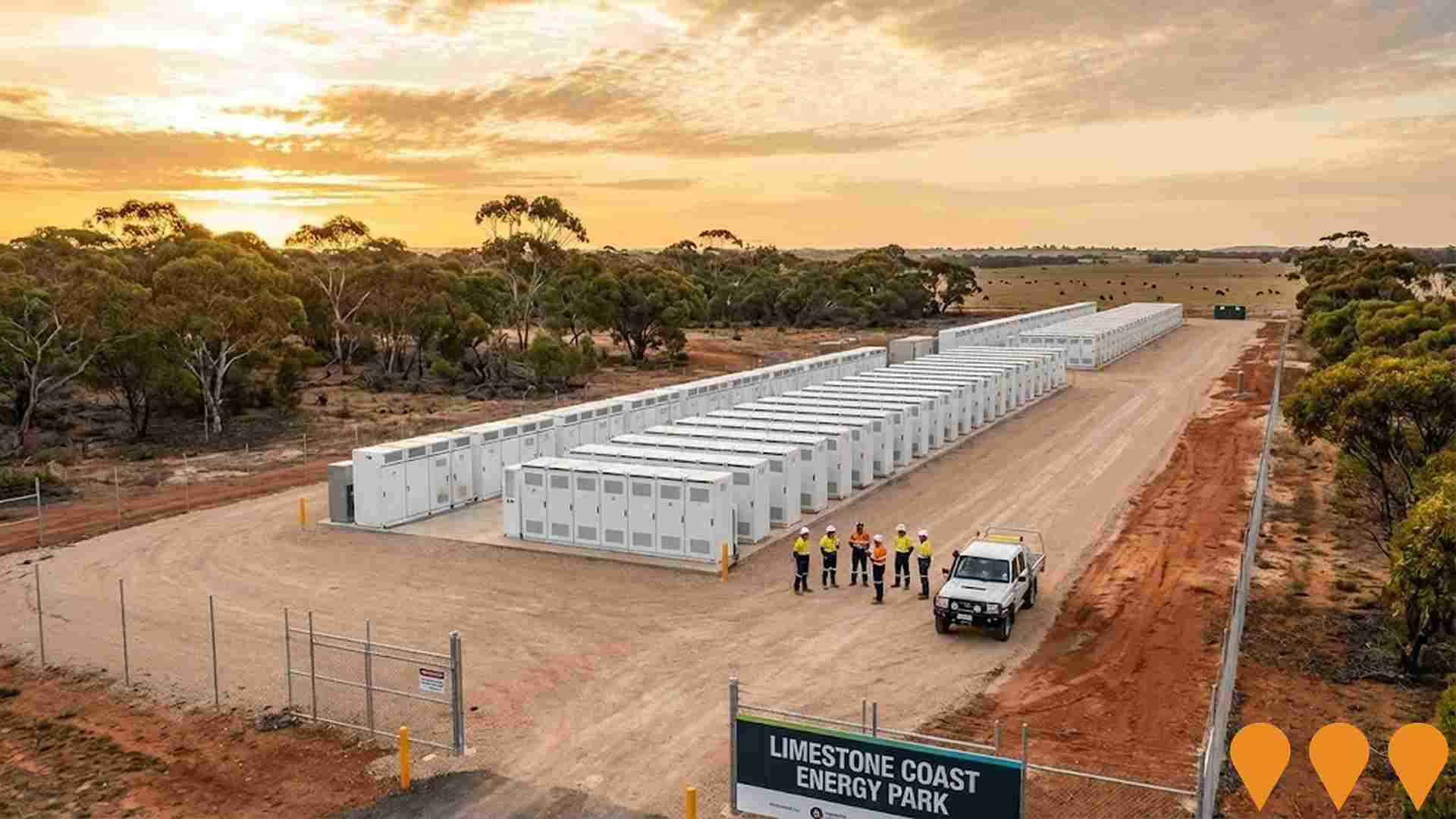
Limestone Coast Energy Park
The Limestone Coast Energy Park includes two co-located batteries totaling 500 MW / 1,500 MWh in South Australia's Limestone Coast area.
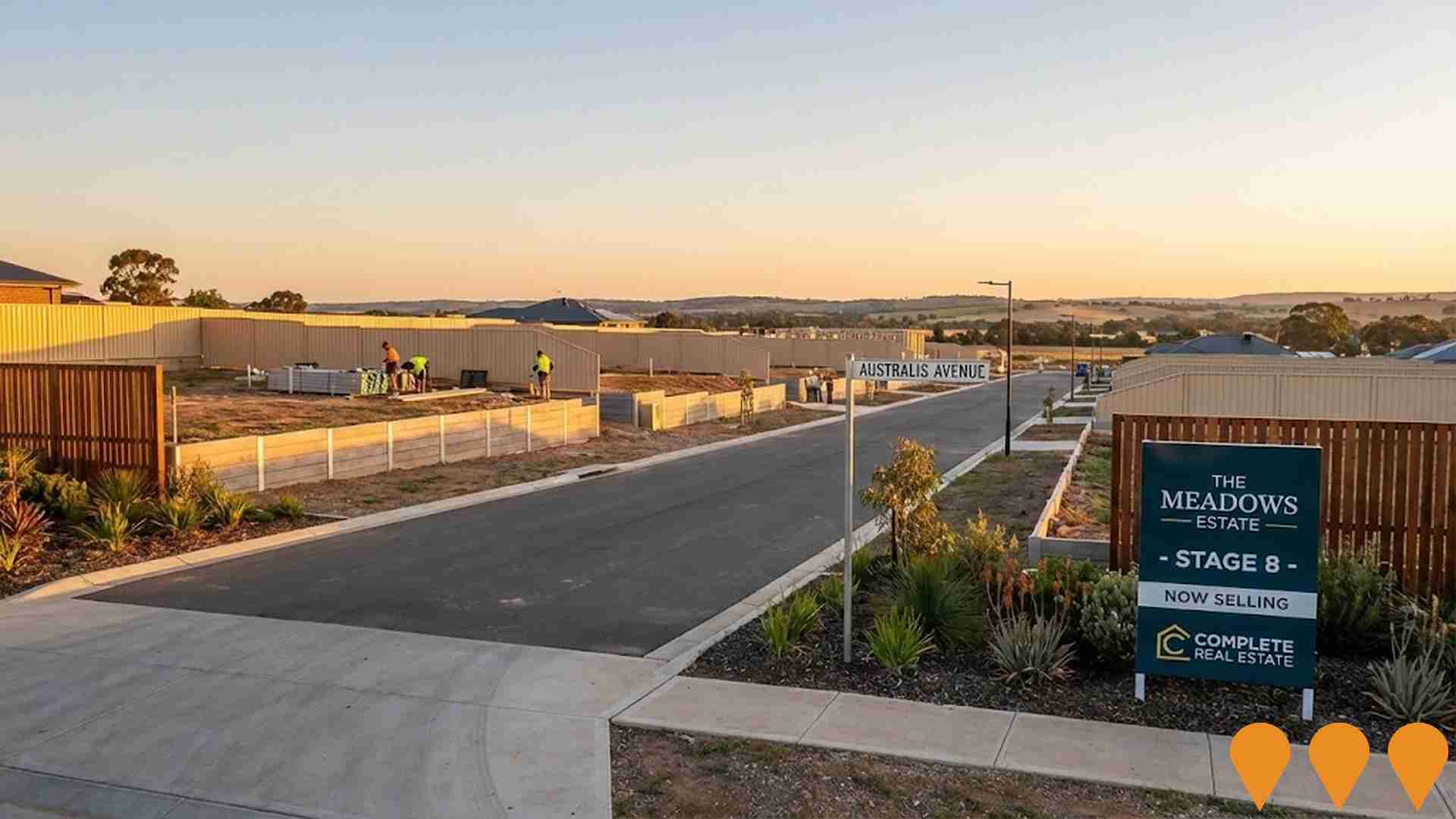
The Meadows Estate
A multi-stage residential estate development in Worrolong, currently progressing through Stage 8. The development offers various allotment sizes ranging from 420m2 to 878m2, with comprehensive services including natural gas, sewerage, SA Water, power and NBN FTTP. Located a short drive from Mount Gambier schools, Marketplace Shopping Centre and Attamurra Golf Course. The estate features level allotments with fencing on three boundary sides and retaining walls included.
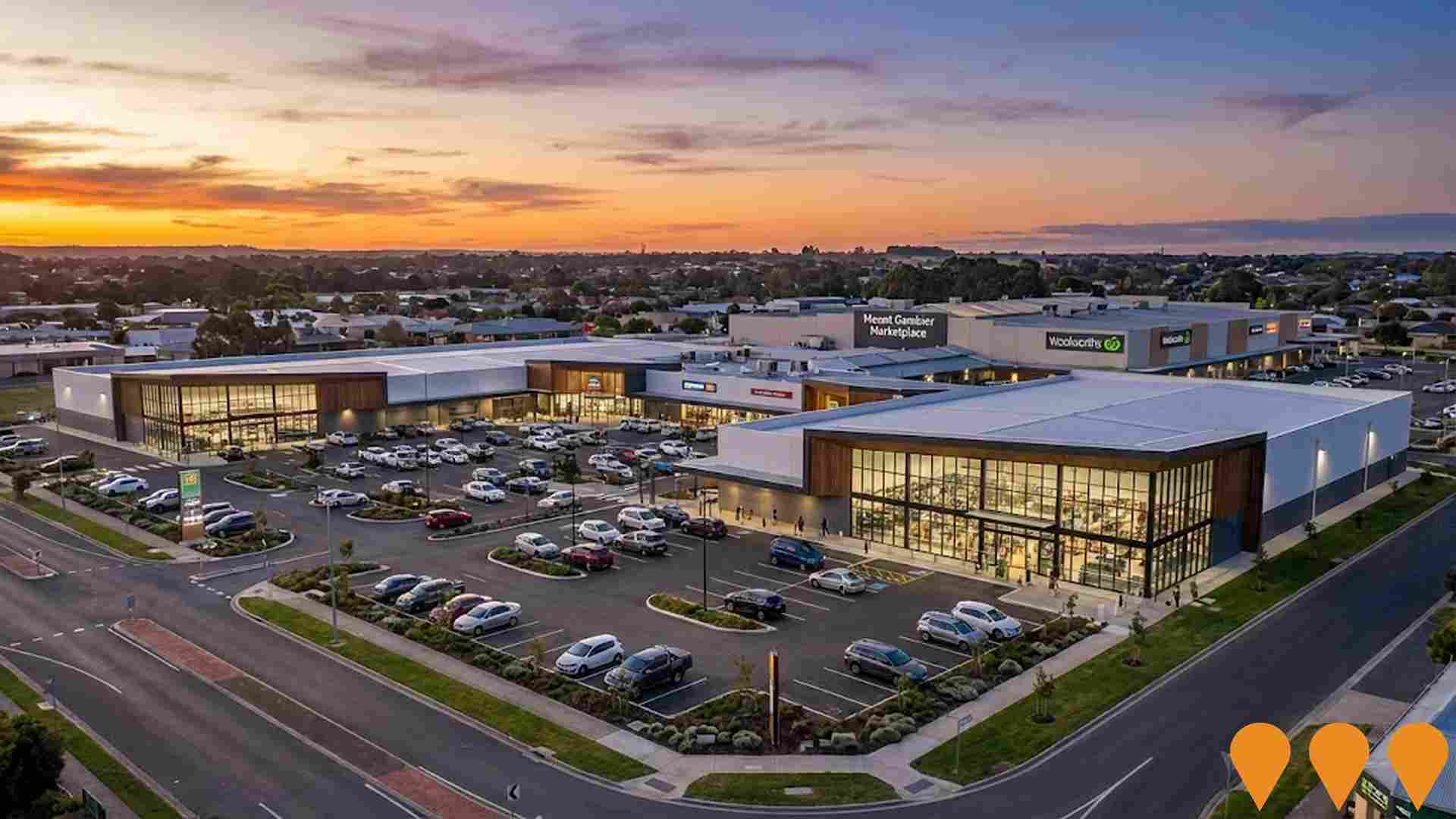
Mount Gambier Marketplace Large Format Retail Expansion
Axiom Properties is developing a 17,000 square metre Large Format Retail precinct on a 6.12-hectare site adjacent to the existing Mount Gambier Marketplace. The project involves two separate lots intended to consolidate the area as the region's primary retail hub. As of mid-2026, the developer is progressing through the planning phase and securing pre-commitments from national tenants, with construction expected to follow the satisfaction of leasing thresholds.
Rail Trail Extension to O'Leary Road
4.2km extension of existing rail trail connecting to O'Leary Road, featuring sealed pathway, rest areas, interpretive signage, and native vegetation restoration. Part of broader cycling and walking network development.
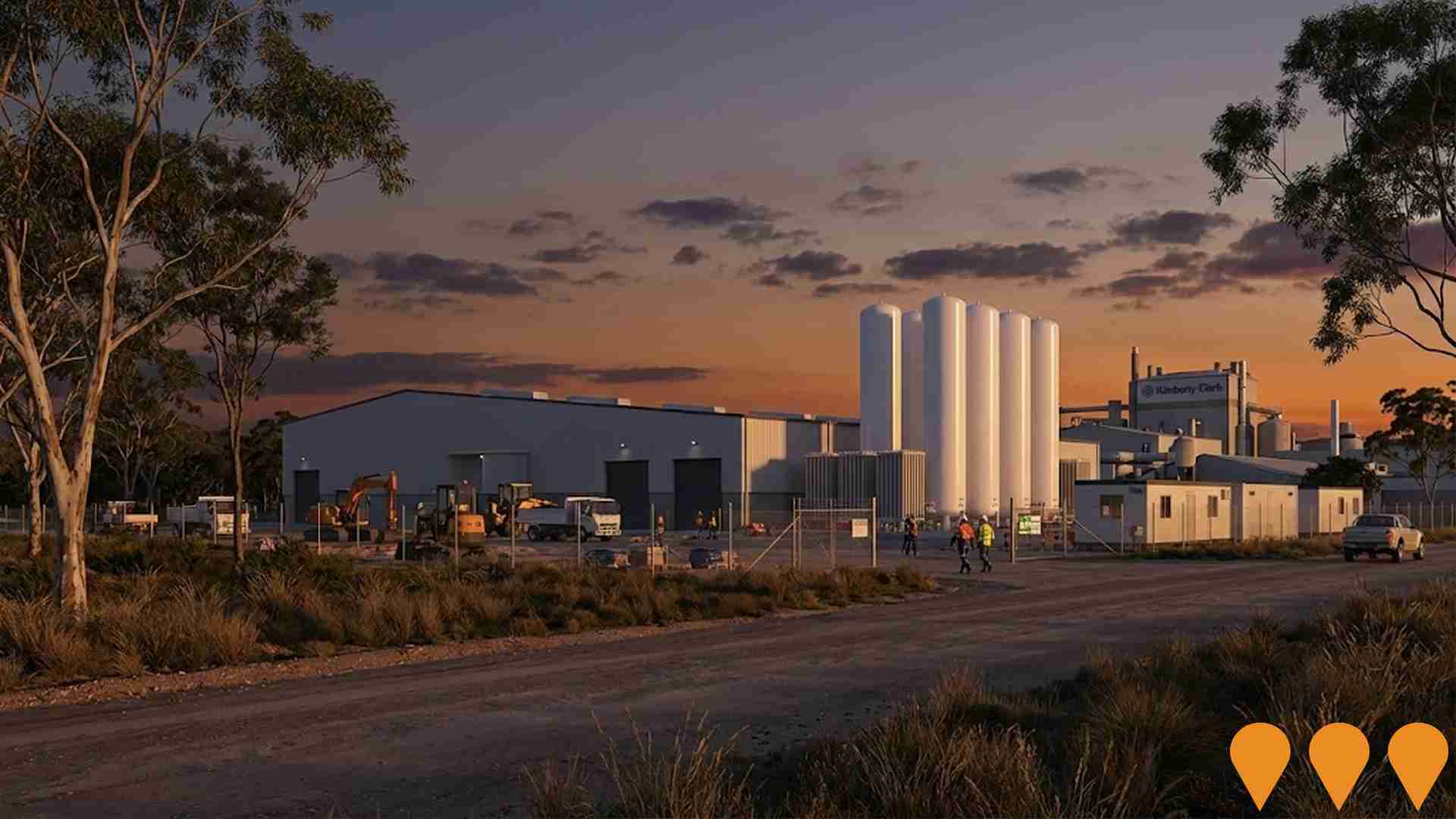
Limestone Coast Hydrogen Hub (LCH2)
The Limestone Coast Hydrogen Hub (LCH2) is a first-of-its-kind industrial decarbonisation project co-located at Kimberly-Clark Australia's Millicent Mill in South Australia's South-East. The hub will produce green hydrogen via electrolysis powered by renewable wind energy from the South Australian Renewable Energy Zone, with KCA secured as the Tier 1 anchor offtake customer from day one. The project is planned in two stages: Stage 1 will blend 20 percent green hydrogen by volume into the existing natural gas supply feeding the mill's co-generation turbine, with first hydrogen production targeted for Q3 2027; Stage 2 will see the mill transition to 100 percent green hydrogen for all process heat by 2029.A 60MW electrolyser is planned, with feasibility study completed in August 2024 by WGA and Linde Engineering. energy south Pty Limited acquired the operating rights from entX in April 2025; project partners include DGA (a Mitsubishi Corporation subsidiary), with binding offtake agreement and FEED commencement expected to follow. Long-term plans include expansion into hydrogen export and derivative products such as green methanol and ammonia.
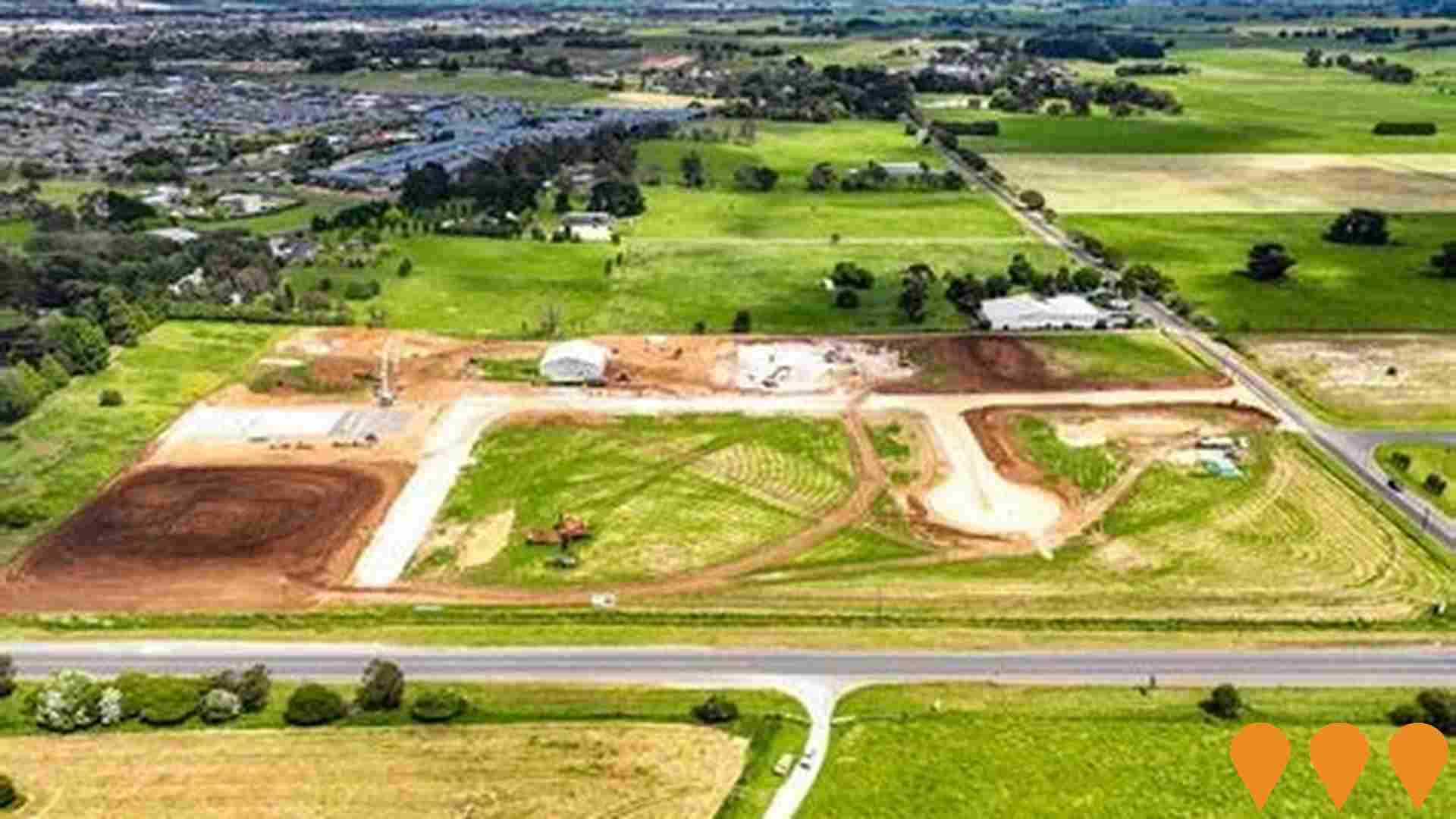
Lot 1 Riddoch Highway Development Potential (Worrolong)
4.99 acres of land in Worrolong with 'Employment' zoning, offering prime development potential for large scale business or future subdivision (STCA). Located on a main arterial road directly opposite Sturm Road, which is under commercial development.




1,768 residents of Penola are employed, from a labour force of 1,819. Unemployment sits at 2.8%, with participation at 67.1%. Weighted for its industry mix, the area's sectors are forecast to grow about 4.0% nationally over five years. That reflects industry composition only and makes no allowance for local population growth. Unemployment and labour force come from ABS Small Area Labour Markets, updated quarterly; the industry and occupation profile is from the 2021 Census.
Detail
Penola maintains a varied employment landscape featuring both blue and white collar positions, supported by substantial manufacturing and industrial operations, an unemployment rate of merely 2.8%, and a 3.5% estimated rise in workforce numbers over the past year. As of March 2026, employed locals total 1,768, while the jobless rate sits 2.7% under the 5.5% documented for Regional SA, and local labor force engagement is elevated at 67.1% against 58.3% for Regional SA. Census findings indicate that only 12.8% of the local workforce carried out their duties from home, though potential distortions from Covid-19 restrictions must be acknowledged.
Workforce participation among local residents is largely focused within agriculture, forestry & fishing, manufacturing, and health care & social assistance. Specialisation in agriculture, forestry & fishing is especially marked, registering a concentration 2.2 times the regional benchmark. Conversely, health care & social assistance occupies a smaller footprint, accounting for 8.1% of local workers relative to 13.9% regionally. Although work options exist locally, a comparison of local residents to Census workplace figures suggests a significant portion travels outside the area for employment. An examination of ABS and SALM figures by AreaSearch reveals that in the year to March 2026, employment grew by 3.5% alongside a 3.8% rise in the labour pool, producing a 0.3 percentage points increase in the unemployment rate. Over the identical timeframe, Regional SA experienced a 1.2% rise in employment, a 2.6% expansion in the labour force, and a 1.4 percentage points climb in unemployment. Medium to long term outlooks are supplemented by national forecasts published by Jobs and Skills Australia in Mar-26. Projected across local sector distributions, these five and ten-year national growth estimates—forecast at 6.6% over five years and 13.7% over ten years nationally—indicate varying trajectories across industries. When weighted against Penola's specific industry distribution, local employment is projected to expand by 4.0% over five years and 10.0% over ten years (note that this model uses direct weighting for scenario purposes and excludes localized population modeling).
Frequently Asked Questions - Employment
Median household income in Penola is $1,314 a week (about $68,000 a year), with median personal income at $737 a week. ATO records put median taxable income at $49,259 a year against an average of $57,877. Household income is from the 2021 Census; taxable income is from ATO Taxation Statistics for the latest financial year available, indexed forward using the ABS Wage Price Index.
Detail
Taxpayer income across the Penola SA2 sits below the nationwide benchmark as reported in ATO records compiled by AreaSearch for financial year 2023. Median taxable earnings within the Penola SA2 reach $49,259 while the mean is $57,877, compared to $48,920 and $58,933 across Regional SA. Incorporating a 10.17% rise in the Wage Price Index since financial year 2023, adjusted estimates reach roughly $54,269 for median and $63,763 for mean earnings as of March 2026. Census evaluations place Penola's personal, family, and household earnings within the modest 21st to 35th percentiles.
Distribution metrics show 30.1% of the cohort (961 individuals) earning within the $1,500 - 2,999 bracket, echoing the 27.5% observed in the wider region. Accommodation expenses remain manageable, with residents retaining 91.6% of income, though net disposable capacity is constrained at the 31st percentile.
Frequently Asked Questions - Income
Penola had 1,224 occupied dwellings at the 2021 Census, 95% detached houses and 1% apartments. 34% are owned with a mortgage, 23% rented and 44% owned outright. At that Census the median rent was $181 a week and the median mortgage repayment $896 a month. Rent absorbs 13.8% of household income here and mortgage repayments 15.7%. Dwelling stock, tenure and housing costs are 2021 Census measures — the only source that counts dwellings at this boundary size.
Detail
According to the most recent Census, the dwelling landscape in Penola consisted of 94.8% standalone houses and 5.2% alternative residential formats (including apartments, semi-detached properties, and 'other' dwellings), contrasting with 88.5% houses and 11.5% other dwellings in Regional SA. Outright property ownership in Penola surpassed Regional SA at 44.0%, while 33.5% of residences were under a mortgage and 22.5% were occupied by renters. Median monthly loan repayments of $896 and median weekly rents of $181 in Penola sat substantially lower than the Regional SA figures of $1,153 and $220. Compared across Australia, Penola maintains notably lower mortgage outlays against the nationwide $1,863 average, alongside weekly rental figures far below the national $375 benchmark.
Frequently Asked Questions - Housing
Penola counted 1,224 households at the 2021 Census, averaging 2.3 people each. 24% are couples with children, against 33% couples without children. 31% of households are people living alone, and families average 2.0 children. Household and family composition is measured only by the Census, so these are 2021 figures.
Detail
Family units constitute 66.2% of all households in the area, encompassing couples without children (32.5%), couples with children (24.1%), and single parent families (9.4%). Non-family living arrangements account for the remaining 33.8%, led by single-person residences at 31.3% and group setups making up 2.3%. The typical household size stands at 2.3 people, aligning perfectly with the Regional SA average.
Frequently Asked Questions - Households
15.4% of adults in Penola hold a university qualification, including 11.2% with a bachelor degree and 1.9% with postgraduate qualifications, lower than 88% of areas nationally. A further 26.9% hold a vocational qualification. 5 schools serve the area, with 375 enrolment places and an average ICSEA of 954 against a national benchmark of 1,000. Qualifications come from the 2021 Census; school enrolments, ICSEA and results come from ACARA's current release.
Detail
Educational attainment in the district presents noticeable headwinds, as higher education attainment (15.4%) sits well beneath the nationwide benchmark of 30.4%, highlighting a clear focus area for future educational programs. Among degree holders, bachelor qualifications comprise 11.2%, graduate diplomas account for 2.3%, and postgraduate degrees represent 1.9%. Vocational learning holds a prominent position locally, with 34.9% of the population aged 15+ possessing technical credentials, encompassing advanced diplomas (8.0%) alongside certificates (26.9%). Engagement with formal study is pronounced locally, with 27.1% of the community undertaking formal courses. This cohort comprises 13.8% attending primary education, 6.7% in secondary education, and 1.9% enrolled in tertiary education.
Frequently Asked Questions - Education
Schools Detail
Getting around Penola means driving: households keep an average of 1.7 vehicles, and scheduled services reach only a handful of stops. Service data is built from operators' published GTFS timetables; vehicle ownership is from the 2021 Census.
Detail
Penola contains 1 active public transport stops within its boundaries, serviced by 2 individual routes providing 10 weekly passenger trips. Public transit access is constrained, with the typical distance to the closest boarding point measuring 8614 meters. With the area functioning mainly as a residential locality, outward travel is standard; driving remains the primary mode of travel at 91%, while 7% commute on foot. Household vehicle access averages 1.7 cars per dwelling, higher than the regional level. An estimated 12.8% of employed individuals worked from home at the 2021 Census, potentially reflecting COVID-19 settings.
Transit schedules provide an average of 1 trips per day across all available lines, representing approximately 10 weekly trips for each designated boarding location.
Frequently Asked Questions - Transport
Transport Stops Detail
64.7% of residents in Penola report no long-term health condition. 6.2% need daily assistance with core activities, and 48.2% hold private health cover. The standardised death rate runs at 4.6 per 1,000 residents. Health conditions, assistance needs and insurance are 2021 Census measures; the death rate comes from current ABS releases.
Detail
General health metrics for Penola inhabitants remain encouraging, with AreaSearch evaluations of chronic illnesses and mortality figures tracking close to nationwide standards across all age demographics, while private medical coverage remains notably restricted at approximately 48% of the local population (~1,540 people) against the 55.7% national figure. Arthritis (10.1%) and mental health conditions (8.5%) represent the most prevalent health issues diagnosed in the locality, while 64.7% of residents reported having no long-term medical conditions, outperforming the 62.5% baseline in Regional SA. The prime working-age demographic records comparatively higher rates of ongoing health ailments.
Seniors aged 65 and over comprise 25.7% of the locality (822 people), below the 27.1% recorded for Regional SA. Older citizens demonstrate favorable health standings, achieving national rankings that surpass the general resident profile.
Frequently Asked Questions - Health
Penola is largely Australian-born, at 90.2% of residents, with 3.3% speaking a language other than English at home. The largest reported ancestries are Australian (34.5%) and English (31.3%). Ancestry, language and country of birth are counted only by the Census, so these are 2021 figures.
Detail
Penola registers below-average measures of cultural diversity, characterized by 88.8% Australian citizenship, 90.2% of the populace born domestically, and 96.7% communicating exclusively in English at home. Christianity forms the dominant faith locally, followed by 44.7% of residents, in line with 45.2% across Regional SA. Looking at parental heritage, the most frequently declared ancestries among Penola residents are Australian at 34.5%, English at 31.3%, and Scottish at 9.6%. Distinct patterns also emerge for other backgrounds, with German ancestry accounting for 6.1% in Penola (compared to 8.2% across the wider region) and Dutch background recorded at 1.3% (against 1.3% regionally).
Frequently Asked Questions - Diversity
The median resident of Penola is 47, older than 84% of areas nationally. 19.6% of residents are aged 15 to 34. Age cohorts are not raw Census counts: the Census split is re-based to the latest ABS population estimates and state projections.
Detail
The age distribution in Penola closely parallels Regional SA, with every primary age bracket remaining within 4.0 percentage points of the Regional SA benchmark. AreaSearch places the median age at 47 as at August 2026, mirroring the figure from the 2021 Census as well as the Regional SA median of 47 at that time, while sitting above the nationwide median of 38 from the same Census. The most noticeable demographic shift post-Census is the expansion of seniors and retirees (65+), growing from 22.5% to an estimated 25.7% of the populace.
Sub-cohort shifts show persons aged 5 to 14 decreasing from 13.0% to an estimated 10.7%, whereas the 15 to 24 band increased from 9.2% to 11.0%, without incoming growth among younger children. Projections to 2041 indicate that senior and retiree demographics will absorb the majority of local growth, gaining 192 residents (23%) to reach 1,014, while contractions are anticipated across youth, young adults, middle-aged groups, and younger retirees.
Frequently Asked Questions - Age
Data & MethodBoundaries, Sources & Method for Penola
9 of 14 data sections on this page were updated within the last 12 months — the newest current to Sep 2026.
Everything is aggregated to the SA2 boundary shown above, on a 2021 Census baseline. Only 3 sections — housing, households and cultural diversity — still wait on the 2026 Census.
The ledger — source, cycle and currency by section
| Section | Source & update cycle | Currency |
|---|---|---|
| Updated within the last 12 months 9 sections | ||
| Population | ABS, GNAF, Geoscience Australia Annual (ABS ERP) | Aug 2026 2 months ago headline measures · 2021 Census baseline |
| Re-based to the ABS Estimated Resident Population (June 2025 release) and updated with new dwellings from GNAF address data. Current to Aug 2026, with the 2021 Census supplying the small-area baseline. | ||
| Age profile | ABS, Geoscience Australia, State governments Annual | Aug 2026 2 months ago headline measures · 2021 Census baseline |
| Age cohorts are re-based to the latest ABS population estimates and state projections, current to Aug 2026. Each cohort is held as a Census baseline and a current estimate. | ||
| Development & approvals | ABS, GNAF Monthly (ABS approvals) | Aug 2026 2 months ago headline measures · Jul 2026 baseline |
| Property sales & rents | Valuer General, Rental Board, ABS Weekly sales, quarterly rents | Sep 2026 last month all 21 measures |
| Sales from the state Valuer General register, refreshed weekly, and rents from quarterly rental bond lodgements. Both are read live each time this page loads, current to Sep 2026. | ||
| Infrastructure projects | Infrastructure Australia, Local governments Daily | May 2026 5 months ago all 2 projects tracked here |
| Project pipeline maintained continuously from Infrastructure Australia, state agencies, local government and public announcements. Records are added and revised daily; this area was last updated May 2026. | ||
| Employment | ABS, DEWR, JSA Quarterly (ABS SALM) | Mar 2026 7 months ago headline measures · 2021 Census baseline |
| Unemployment and labour force from ABS Small Area Labour Markets, current to Mar 2026. The growth outlook applies Department of Employment (now Jobs and Skills Australia) forecasts for all 19 industry divisions to the local industry mix, so it measures sector composition rather than local expansion and makes no allowance for population growth. Job demand comes from the same agency via its Internet Vacancy Index; industry and occupation structure from the 2021 Census. | ||
| Education | ABS, ACARA Annual (ACARA) | Sep 2026 last month headline measures · 2021 Census baseline |
| Transport | ABS, State Transport Departments Each timetable release | Jul 2026 3 months ago headline measures · 2021 Census baseline |
| Services & amenities | Provider directories, ACECQA Continuous | Sep 2026 last month all 14 measures |
| Annual and financial-year sources 2 sections | ||
| Income | ABS, ATO Annual (ATO) | FY 2023 3 years ago headline measures · 2021 Census baseline |
| ATO taxable income statistics for FY 2023, indexed forward using the Wage Price Index. Census household income provides the distribution detail. | ||
| Health | ABS, ATO Annual | 2024 2 years ago headline measures · 2021 Census baseline |
| Census-measured — next update: 2026 Census 3 sections No more current small-area source exists for these, so they are labelled as Census-measured rather than implied to be current. | ||
| Housing | ABS 5-yearly (Census) | 2021 Census next update 2026 all 30 measures |
| Households | ABS 5-yearly (Census) | 2021 Census next update 2026 all 18 measures |
| Cultural diversity | ABS, Geoscience Australia 5-yearly (Census) | 2021 Census next update 2026 all 44 measures |
"Currency" is the most recent release feeding that section. Where the Census supplies the structural baseline underneath a current headline figure, the row says so.
How the numbers are built
Population
The Census provides the small-area baseline, aggregated from mesh blocks to this boundary. It is then re-based to the ABS Estimated Resident Population (June 2025 release), and new dwellings built since Census night are counted from address data — 25 validated new addresses here. The headline figure is therefore a current estimate for Aug 2026, not a 2021 count (3,107 at the 2021 Census → 3,196 now). Annual growth rates are compound (CAGR), not simple averages.
Age profile
Cohort shares are not raw Census counts. Every cohort is held as a pair — the Census baseline and a current estimate — and the split is re-based using ERP and state population projections, current to Aug 2026. Median age is the Census median plus modelled change since. Charts that show both are labelled "2021 Census vs Current Estimate".
Property sales
Sourced from the state valuation authority's sales register — current, not Census, and refreshed weekly. Medians are calculated from settled transactions in the period shown; periods with very low transaction counts are flagged or suppressed, because a handful of sales can move a median substantially.
Rents
Derived from state rental bond lodgement data, by dwelling type and bedroom count. Bonds are lodged at the start of a new tenancy, so this reflects new lettings, not the whole rented stock.
Development & infrastructure
Building approvals come from current ABS releases; development applications are collected from council and state planning portals; the infrastructure pipeline is compiled from Infrastructure Australia and local government sources. Applications are matched to this boundary by address or coordinates, so very recent lodgements may not yet appear.
Employment & income
Industry and occupation structure comes from the Census, but the headline labour-market indicators do not. Unemployment and labour force are derived from ABS Small Area Labour Markets (quarterly). The employment outlook applies Department of Employment forecasts for all 19 industry divisions to this area's own industry mix (the agency is now Jobs and Skills Australia), as does the Internet Vacancy Index used for job demand. Because it is weighted on industry composition alone, that outlook carries no allowance for local population growth — in fast-growing areas the real rise in local jobs will typically be higher. Income combines Census household income with ATO taxable-income statistics for FY 2023, indexed forward using the Wage Price Index.
Education, transport & amenities
School enrolments, ICSEA and performance come from ACARA's current release, not the Census. Public transport stops and service frequency are derived from GTFS timetable feeds published by state transport departments. Services and amenities are proximity and count scores built from provider directories, refreshed on their own cycle. The Census contributes only the travel-to-work and qualification measures.
Rankings and benchmarks. Where we rank this area, the comparison set is every area of the same boundary type — suburbs against suburbs, SA2s against SA2s. Benchmarks compare this area against its greater capital city region and the national figure for the same measure and period.
Limits worth knowing. Small areas carry larger error margins, and the ABS introduces small random adjustments to Census counts to protect confidentiality — so totals may not sum exactly. Estimates re-based from regional data describe the area's expected trajectory, not a direct count of it. Figures are indicative for research and are not financial, planning or valuation advice.
Cross-check us. The Census baseline for this boundary is at ABS 2021 Census QuickStats (407021156). QuickStats reports 2021 only — the figures on this page are more current wherever the ledger shows a later date.