Chart Color Schemes
est. as @ -- *
2021 Census | -- people
Sales Activity
Curious about local property values? Filter the chart to assess the volume and appreciation (including resales) trends and regional comparisons, or scroll to the map below view this information at an individual property level.
Find a Recent Sale
Sales Detail
Population
Surfers Paradise lies within the top 10% of areas nationally in terms of population growth performance according to AreaSearch analysis of short and medium-term trends
As of Nov 2025, Surfers Paradise's population is estimated at around 31,431. This reflects an increase of 5,019 people since the 2021 Census, which reported a population of 26,412. The change is inferred from the resident population of 31,214, estimated by AreaSearch following examination of the latest ERP data release by the ABS (June 2024), and an additional 1,403 validated new addresses since the Census date. This level of population equates to a density ratio of 5,419 persons per square kilometer, placing Surfers Paradise in the top 10% of national locations assessed by AreaSearch. The suburb's 19.0% growth since the 2021 census exceeded the non-metro area (8.8%) and the national average, marking it as a growth leader in the region. Population growth was primarily driven by overseas migration contributing approximately 83.0%.
AreaSearch adopts ABS/Geoscience Australia projections for each SA2 area, released in 2024 with 2022 as the base year. For areas not covered and years post-2032, Queensland State Government's SA2 area projections are adopted, released in 2023 based on 2021 data. Exceptional growth is predicted over the period to 2041, with Surfers Paradise expected to increase by 17,977 persons, reflecting an increase of 56.5% in total over the 17 years.
Frequently Asked Questions - Population
Development
The level of residential development activity in Surfers Paradise was found to be higher than 90% of real estate markets across the country
Based on AreaSearch analysis of ABS building approval numbers allocated from statistical area data, Surfers Paradise has seen around 739 new homes approved annually over the past five financial years, totalling an estimated 3698 homes. As of FY-26 so far, 45 approvals have been recorded. Over these five years (FY-21 to FY-25), there was an average of 1.4 people moving to the area per dwelling built, indicating a balanced supply and demand market that supports stable conditions. The average construction value for new properties is $1159000, reflecting developer focus on the premium segment with upmarket properties.
In FY-26, there have been $25.1 million in commercial development approvals recorded, demonstrating moderate levels of commercial development. Compared to the Rest of Qld, Surfers Paradise records elevated construction activity, 29% above regional average per person over these five years, offering good buyer choice while supporting existing property values. This activity is well above national averages, reflecting strong developer confidence in the area. New building activity shows 2% standalone homes and 98% medium to high-density housing, attracting downsizers, investors, and first-time purchasers. With around 33 people per dwelling approval, Surfers Paradise exhibits growth area characteristics.
According to AreaSearch's latest quarterly estimate, Surfers Paradise is expected to grow by 17760 residents through to 2041. Given current construction levels, housing supply should meet demand adequately, creating favourable conditions for buyers while potentially enabling growth that exceeds current forecasts.
Frequently Asked Questions - Development
Infrastructure
Surfers Paradise has very high levels of nearby infrastructure activity, ranking in the top 10% nationally
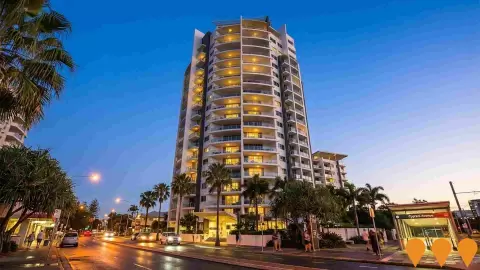
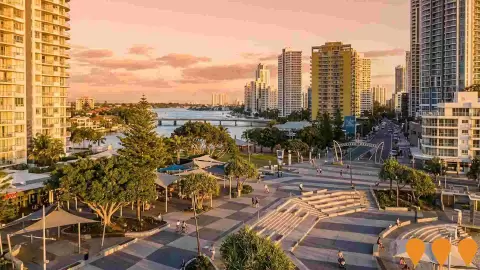
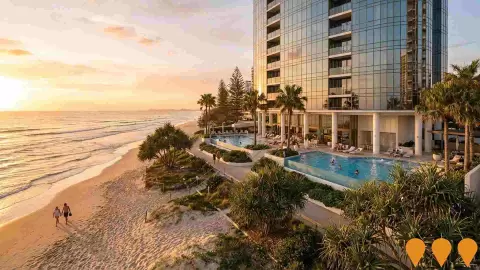
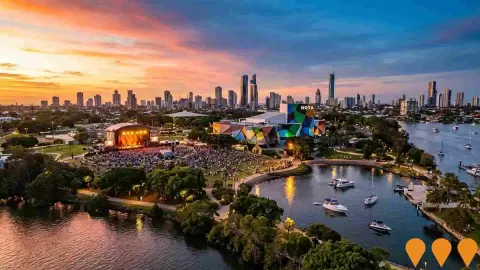
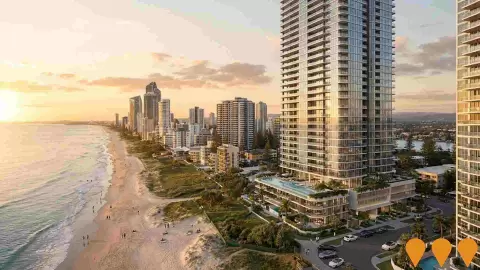
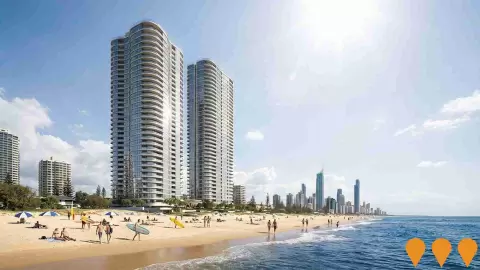
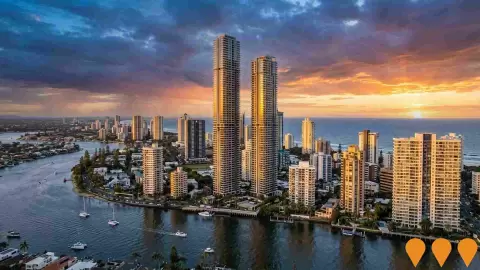
Changes in local infrastructure significantly affect an area's performance. AreaSearch has identified 49 potential impact projects. Notable ones are River Terrace, South Beach, Surfers Paradise, Surfers Paradise Revitalisation, and COAST, as detailed below for relevance.
Professional plan users can use the search below to filter and access additional projects.
INFRASTRUCTURE SEARCH
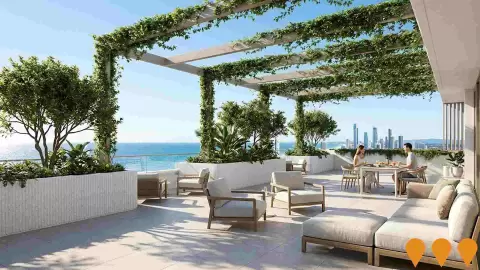
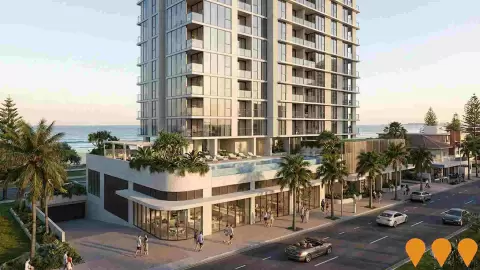
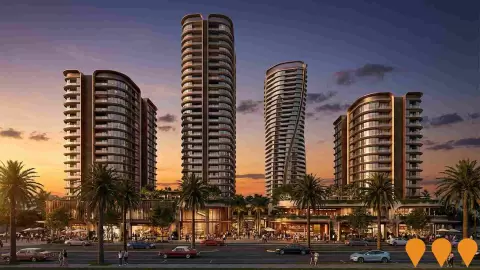
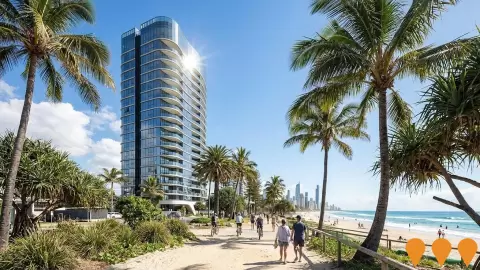
Denotes AI-based impression for illustrative purposes only, not to be taken as definitive under any circumstances. Please follow links and conduct other investigations from the project's source for actual imagery. Developers and project owners wishing us to use original imagery please Contact Us and we will do so.
Frequently Asked Questions - Infrastructure
Surfers Paradise Revitalisation
The $100 million Surfers Paradise Revitalisation project by City of Gold Coast will transform Cavill Avenue, Cavill Mall and The Esplanade into a world-class event, dining, entertainment and entertainment destination. Key features include removal of through traffic to create over 5,000mý of additional public space, a beachside amphitheatre with terraced seating, increased tree canopy and shade structures, enhanced pedestrian safety and mobility, and a reimagined Oceanway. A three-month pedestrianisation trial ('The People's Esplanade') on a 250m section between Soul and Hanlan Street runs August to November 2025. Final construction is scheduled to commence in 2028 with completion by mid-2029.
River Terrace
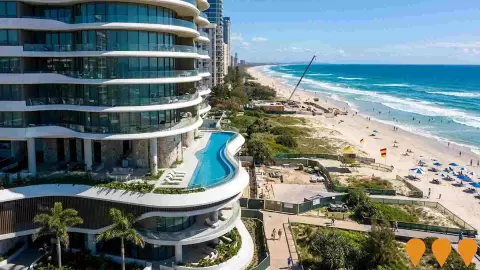
A redesigned twin-tower mixed-use development featuring two twisting towers of 34 and 46 storeys. The project comprises 508 residential apartments and 280 short-term hotel suites, with extensive infinity edge swimming pools at podium level designed to evoke a seamless transition between the ocean and the river. The towers feature wrap-around balconies and floor-to-ceiling glazing with views of the ocean, river and hinterland.
South Beach, Surfers Paradise
Twin-tower residential development by Andrews Projects inspired by modernist Miami architecture. Comprises two 38-storey curved towers with 394 one, two, three and four-bedroom apartments (total 394 apartments). Features over 5,500 mý of wellness-focused resident amenities including pools, 300 mý gymnasium, Hammam, spa, sauna, steam room, treatment rooms, co-working spaces and lounges. Construction commenced in 2025, with completion expected in 2028. Estimated value $700 million.
Exhale Surfers Paradise
Boutique 25-level residential tower by Siera Group comprising 54 apartments with extensive amenities across two levels. Features spa, gym, sauna, lap pool, and premium finishes. Located 60m from Surfers Paradise beachfront.
COAST
A 38-level absolute beachfront residential tower offering 53 premium residences, including half and full-floor apartments, sky homes, and a penthouse. The development features six-star amenities including a 32m wet edge pool, yoga studio, commercial gym, sauna, and concierge services. Construction by Multiplex is progressing well with basements and ground floor completed.
Paradiso Place
Australia's first luxury oceanside neighbourhood comprising 3 residential towers (38, 40, 42 storeys) with 792 apartments, retail plaza, suspended glass-bottom lap pool, and resort-style amenities. Features smart home technology and world-class sales gallery.
26 Vista
A cosmopolitan collection of 280 apartments and unique townhomes soaring 51 levels into the Gold Coast skyline, setting new standards for stylish and sustainable coastal living with ocean views, premium finishes, and resort-style amenities in a prime Surfers Paradise location.
Royale Gold Coast
A 38-level luxury beachfront tower developed by DD Living, offering 104 ultra-luxury 2, 3, and 4-bedroom residences, sky homes, and penthouses. Features resort-style amenities including two swimming pools, wellness centre with sauna and gym, and executive club lounge. Positioned on absolute beachfront in Surfers Paradise, with construction progressing towards completion in 2026.
Employment
AreaSearch analysis indicates Surfers Paradise maintains employment conditions that align with national benchmarks
Surfers Paradise has a highly educated workforce with prominent tourism and hospitality sectors. Its unemployment rate was 3.2% in the past year, lower than the Rest of Queensland's (RoQ) 3.9%.
Employment growth was estimated at 2.2% over this period. As of June 2025, 18,055 residents are employed with an unemployment rate of 0.7% below RoQ's rate. Workforce participation is lower than the state average (55.7% vs. RoQ's 59.1%).
Leading industries include accommodation & food, health care & social assistance, and retail trade. Accommodation & food employment is particularly high at 2.2 times the regional average. Conversely, agriculture, forestry & fishing employs only 0.4%, compared to RoQ's 4.5%. Many residents commute elsewhere for work based on Census data. Between June 2024 and June 2025, employment increased by 2.2% while labour force grew by 2.1%, keeping unemployment relatively stable at 3.2%. In contrast, RoQ experienced employment growth of 1.8% with a slight rise in unemployment to 4.1%. National employment forecasts from Jobs and Skills Australia (Sep-22) project national employment growth of 6.6% over five years and 13.7% over ten years. Applying these projections to Surfers Paradise's employment mix suggests local employment should increase by 6.5% over five years and 13.4% over ten years, though this is a simple extrapolation for illustrative purposes only.
Frequently Asked Questions - Employment
Income
Income figures position the area below 75% of locations analysed nationally by AreaSearch
Surfers Paradise's median income among taxpayers was $44,991 in financial year 2022. The average income stood at $74,474 during the same period. This compares to figures for Rest of Qld's of $50,780 and $64,844 respectively. Based on Wage Price Index growth of 13.99% since financial year 2022, current estimates would be approximately $51,285 (median) and $84,893 (average) as of September 2025. According to the 2021 Census figures, personal income ranks at the 43rd percentile with weekly earnings of $775, while household income sits at the 21st percentile. Income brackets indicate that 28.9% of individuals in Surfers Paradise earn between $1,500 and $2,999 per year (9,083 individuals). Housing affordability pressures are severe with only 78.3% of income remaining after housing costs, ranking at the 16th percentile. The area's SEIFA income ranking places it in the 5th decile.
Frequently Asked Questions - Income
Housing
Surfers Paradise features a more urban dwelling mix with significant apartment living, with a higher proportion of rental properties than the broader region
In Surfers Paradise, as per the latest Census evaluation, 10.1% of dwellings were houses while 89.8% were other types such as semi-detached homes, apartments, and 'other' dwellings. This contrasts with Non-Metro Qld's figures of 25.1% houses and 74.9% other dwellings. Home ownership in Surfers Paradise stood at 28.0%, with mortgaged dwellings at 19.0% and rented ones at 53.0%. The median monthly mortgage repayment was $1,606, lower than Non-Metro Qld's average of $1,950. The median weekly rent in Surfers Paradise was $410, compared to Non-Metro Qld's $437. Nationally, Surfers Paradise's mortgage repayments were significantly lower at $1,606 than the Australian average of $1,863, while rents were higher at $410 compared to the national figure of $375.
Frequently Asked Questions - Housing
Household Composition
Surfers Paradise features high concentrations of lone person households and group households, with a lower-than-average median household size
Family households account for 50.9% of all households, including 11.0% couples with children, 31.6% couples without children, and 7.0% single parent families. Non-family households make up the remaining 49.1%, with lone person households at 39.9% and group households comprising 9.2%. The median household size is 1.9 people, which is smaller than the Rest of Qld average of 2.1.
Frequently Asked Questions - Households
Local Schools & Education
The educational profile of Surfers Paradise exceeds national averages, with above-average qualification levels and academic performance metrics
Educational attainment in Surfers Paradise is high, with 32.3% of residents aged 15+ holding university qualifications compared to 20.6% in the rest of Queensland and 25.4% in the SA4 region. Bachelor degrees are most common at 22.6%, followed by postgraduate qualifications (7.2%) and graduate diplomas (2.5%). Vocational credentials are also prevalent, with 37.2% of residents aged 15+ holding such qualifications - advanced diplomas account for 15.1% and certificates for 22.1%. Educational participation is notable, with 31.5% of residents currently enrolled in formal education.
This includes 7.7% in tertiary education, 4.9% in primary education, and 4.3% pursuing secondary education. Surfers Paradise State School serves the area, with an enrollment of 615 students as of a recent report. The school's ICSEA value is 1038, indicating typical Australian school conditions with balanced educational opportunities. It caters exclusively to primary education, with secondary options available in nearby areas. Local school capacity is limited at 2.0 places per 100 residents compared to the regional average of 7.7, leading many families to travel for schooling.
Frequently Asked Questions - Education
Schools Detail
Nearby Services & Amenities
Transport
Transport servicing is moderate compared to other areas nationally based on assessment of service frequency, route connectivity and accessibility
Transport analysis indicates 55 active stops in Surfers Paradise offering mixed train, light rail, bus services. These stops are served by 13 routes facilitating 2968 weekly passenger trips. Transport access is rated good with residents averaging 202 meters from nearest stop.
Service frequency averages 424 daily trips across all routes, equating to approximately 53 weekly trips per individual stop.
Frequently Asked Questions - Transport
Transport Stops Detail
Health
The level of general health in Surfers Paradise is notably higher than the national average with both young and old age cohorts seeing low prevalence of common health conditions
Surfers Paradise shows superior health outcomes for both young and elderly populations, with low prevalence of common health conditions.
Approximately 57% (~17,824 people) have private health cover, which is high compared to other areas. The most prevalent medical conditions are arthritis (7.7%) and mental health issues (7.1%). About 72.2% of residents report no medical ailments, slightly higher than the Rest of Qld's 72.6%. The area has a lower proportion of seniors aged 65 and over at 20.8% (6,537 people) compared to Rest of Qld's 21.8%. Senior health outcomes are notably strong, outperforming general population metrics.
Frequently Asked Questions - Health
Cultural Diversity
Surfers Paradise is among the most culturally diverse areas in the country based on AreaSearch assessment of a range of language and cultural background related metrics
Surfers Paradise has a significant cultural diversity, with 28.3% of its population speaking a language other than English at home and 45.6% born overseas. Christianity is the predominant religion in Surfers Paradise, making up 47.4% of its population. Judaism is notably overrepresented in Surfers Paradise compared to the rest of Queensland, with 0.6% of the population identifying as Jewish.
The top three ancestry groups are English at 25.8%, Australian at 16.8%, and Other at 15.5%. Some ethnic groups have notable divergences: Spanish is overrepresented at 1.4%, French at 0.9%, and Russian at 0.7% compared to regional averages.
Frequently Asked Questions - Diversity
Age
Surfers Paradise hosts an older demographic, ranking in the top quartile nationwide
Surfers Paradise has a median age of 40, which is close to Rest of Qld's figure of 41 and exceeds the national norm of 38. The 25-34 age group constitutes 25.5% of Surfers Paradise's population, higher than Rest of Qld but lower than the national average of 14.5%. Meanwhile, the 5-14 cohort makes up 3.9%, which is less prevalent compared to other regions. Post the 2021 Census, younger residents have lowered the median age by 1.5 years to 40. Specifically, the 25-34 age group has risen from 21.4% to 25.5%, while the 15-24 cohort increased from 10.8% to 12.1%. Conversely, the 45-54 cohort decreased from 12.3% to 10.4%, and the 65-74 group fell from 12.7% to 11.2%. By 2041, Surfers Paradise's age composition is projected to shift notably. The 25-34 cohort is expected to grow by 67%, adding 5,397 residents to reach a total of 13,412.