Chart Color Schemes
est. as @ -- *
2021 Census | -- people
Sales Activity
Curious about local property values? Filter the chart to assess the volume and appreciation (including resales) trends and regional comparisons, or scroll to the map below view this information at an individual property level.
Find a Recent Sale
Sales Detail
Population
Population growth drivers in Alexandra Headland are strong compared to national averages based on AreaSearch's ranking of recent, and medium to long-term trends
Alexandra Headland's population was estimated at 4,235 people as of Nov 2021. By Nov 2025, the population is estimated to be around 4,414, an increase of 179 people (4.2%). This growth is inferred from AreaSearch's validation of new addresses and ABS ERP data released in June 2024, which estimates a resident population of 4,400 for the suburb. The population density stands at 2,942 persons per square kilometer, placing Alexandra Headland in the upper quartile nationally according to AreaSearch assessments. Overseas migration was the primary driver behind this growth.
For future projections until 2032, AreaSearch uses ABS/Geoscience Australia data released in 2024 with a 2022 base year. Post-2032, Queensland State Government's SA2 area projections from 2023 are adopted for areas not covered by the ABS data. These state projections do not provide age category splits; thus, AreaSearch applies proportional growth weightings based on ABS Greater Capital Region projections released in 2023 using 2022 data. By 2041, Alexandra Headland's population is expected to increase by 404 persons, reflecting a gain of 10.0% over the 17-year period.
Frequently Asked Questions - Population
Development
Residential development activity is lower than average in Alexandra Headland according to AreaSearch's national comparison of local real estate markets
Based on AreaSearch analysis of ABS building approval numbers, allocated from statistical area data, Alexandra Headland averaged around 6 new dwelling approvals each year between FY21 and FY25. Approximately 30 homes were approved over the past five financial years, with an additional 5 approved in FY26. On average, 4.8 people moved to the area for each dwelling built during this period.
This significant demand exceeds new supply, typically leading to price growth and increased buyer competition. New homes are being constructed at an average expected cost of $1,120,000, indicating developers target the premium market segment with higher-end properties. In FY26, $1.1 million in commercial approvals have been registered, suggesting a predominantly residential focus. Compared to the Rest of Qld, Alexandra Headland records markedly lower building activity, at 83.0% below the regional average per person. This scarcity of new properties usually strengthens demand and prices for existing properties.
The area's building activity level is also under the national average, indicating its established nature and suggesting potential planning limitations. New development consists of 67.0% detached houses and 33.0% townhouses or apartments, providing options across different price points. Notably, developers are constructing more detached housing than the existing pattern implies (36.0% at Census), reflecting persistent strong demand for family homes amid densification trends. With around 633 people per dwelling approval, Alexandra Headland reflects a highly mature market. Looking ahead, AreaSearch estimates Alexandra Headland is expected to grow by 440 residents through to 2041. Should current construction levels persist, housing supply could lag population growth, likely intensifying buyer competition and underpinning price growth.
Frequently Asked Questions - Development
Infrastructure
Alexandra Headland has very high levels of nearby infrastructure activity, ranking in the top 20% nationally
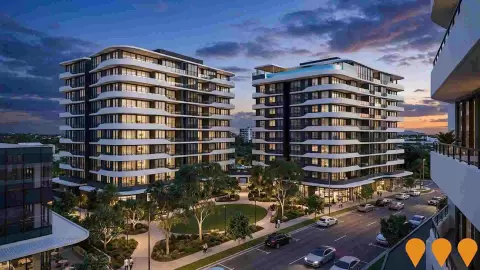
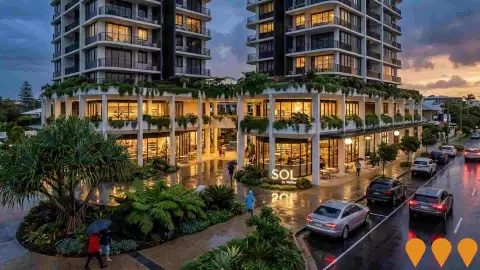
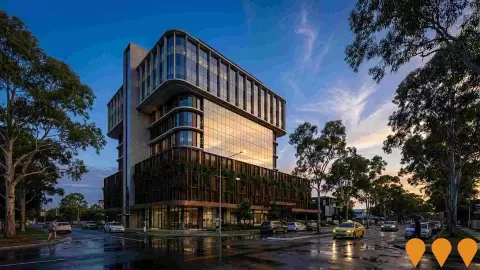
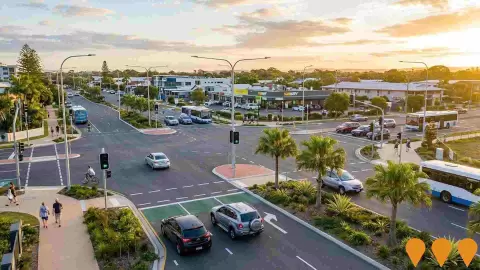
Local infrastructure changes significantly impact an area's performance. AreaSearch has identified five projects likely to affect this region. Notable projects include SOL by Walker at Maroochydore City Centre, Alex Bluff Foreshore Coastal Pathway, Mooloolaba Foreshore Revitalisation Project, and Mooloolaba Transport Corridor Upgrade. The following list details those most relevant.
Professional plan users can use the search below to filter and access additional projects.
INFRASTRUCTURE SEARCH
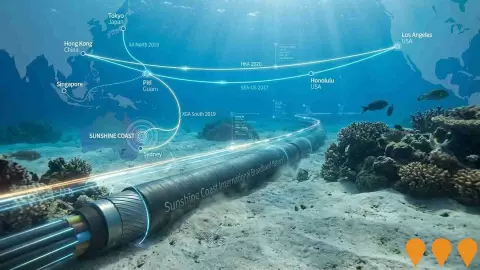
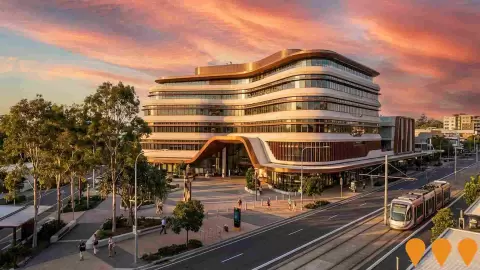
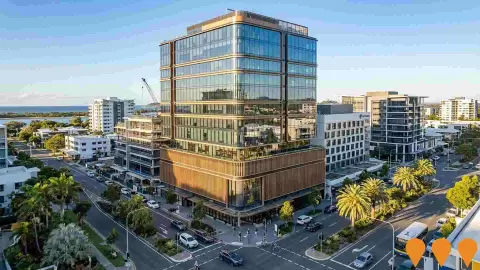
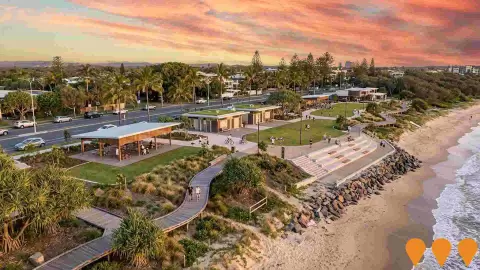
Denotes AI-based impression for illustrative purposes only, not to be taken as definitive under any circumstances. Please follow links and conduct other investigations from the project's source for actual imagery. Developers and project owners wishing us to use original imagery please Contact Us and we will do so.
Frequently Asked Questions - Infrastructure
Sunshine Coast Infrastructure Coordination Plan
A collaborative plan between the Queensland Government and Sunshine Coast Council to coordinate infrastructure for the Sunshine Coast Urban Corridor (Maroochydore to Caloundra). It outlines network constraints, planned network requirements, and co-location opportunities across various infrastructure classes (transport, energy, water, education, health, and social) to support significant population and employment growth up to 2041 and beyond. It is a priority action of the State Infrastructure Strategy.
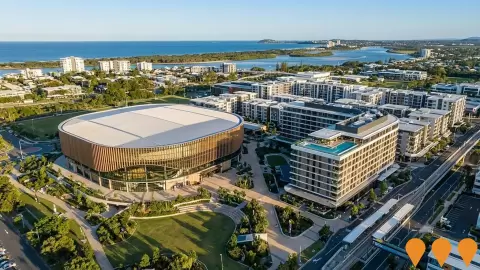
Brisbane 2032 Olympics Horizon Centre
The $1 billion Horizon Centre is a landmark infrastructure project for the Brisbane 2032 Olympic and Paralympic Games. Located in the Maroochydore City Centre, the precinct will feature a 7,000-seat multi-format indoor arena, a 5-star hotel, and an athlete village accommodating 1,400 athletes. Post-Games, the arena will evolve into a premier arts, music, convention, and exhibition centre, while the athlete village will be repurposed into permanent accommodation. The project is being delivered through a Public Private Partnership (PPP) and will integrate with the new 'The Wave' public transport connection.
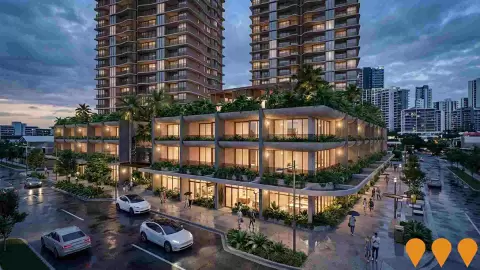
SOL by Walker - Maroochydore City Centre
Twin 19-storey towers with 251 apartments, townhouses and penthouses in the heart of Maroochydore's new CBD. Two 19-storey residential towers and three-storey commercial complex comprising 251 one to four-bedroom dwellings, 2162sqm of commercial space and 401 car parks. Features luxury amenities, resort-style facilities including 20m pool, gym, spa, and ground-floor retail shops, bars and restaurants. Part of Australia's largest greenfield CBD development. Designed by Plus Architecture with construction commencing 2025.
Mooloolaba Foreshore Revitalisation Project
Major foreshore revitalisation project to create more beachfront parkland, new community facilities, improve beach access and enhance coastal protection. Construction expected to start July 2025 and continue through 2026/early 2027.
Mooloolaba - Alexandra Headland Local Plan Area
Local plan area within the Proposed Sunshine Coast Planning Scheme 2025. The LPA covers Mooloolaba and Alexandra Headland and proposes targeted redevelopment and revitalisation near main centres and public transport routes (including potential high frequency public transport). Key proposed changes include selected rezonings (e.g. parts of Mari Street to Tourist Accommodation; mixed use along Brisbane Road/Walan Street), building height updates (e.g. several areas to 6-8 storeys with metre equivalents), and reduced minimum lot sizes in parts of the low density zone. Formal public consultation on the proposed scheme ran 15 July to 19 September 2025.
SOL by Walker
A premium residential development comprising 251 dwellings across two 19-storey towers, including 1-4 bedroom apartments, SOHO townhouses, and penthouses, with ground-floor retail and commercial spaces. Features resort-style amenities including rooftop terraces, pool deck, gym, co-working spaces, and sunset lawn. Located in the heart of Maroochydore City Centre with direct access to retail, dining and green spaces.
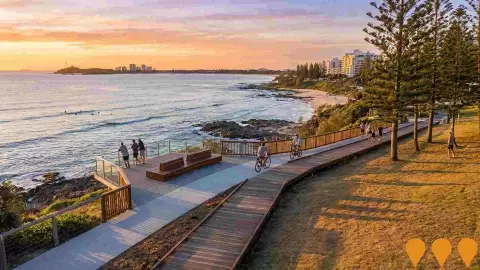
Mooloolaba to Maroochydore Cycleway - Alexandra Headland (Stage 6)
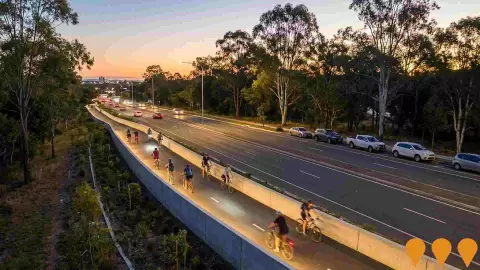
Stage 6 delivers a 1.2 km, 5 m wide off-road shared path along Alexandra Parade from Mary Street to Sixth Avenue. The design responds to community feedback, aims for no net loss of beachside parking, adds crossings and parking upgrades, and improves safe active transport connections between Alexandra Headland and Maroochydore.
Sunshine Motorway, Mooloolah River Interchange Upgrade (Stage 1)
Stage 1 of the Mooloolah River Interchange Upgrade on the Sunshine Motorway addresses safety, congestion, and traffic weaving issues on the Sunshine Coast. Key features include a new overpass connecting Nicklin Way northbound directly to Brisbane Road at Mooloolaba, a new local road link between Karawatha Drive (Mountain Creek) and Brisbane Road, new signalised intersections, active transport provisions for pedestrians and cyclists, and separation of local and motorway traffic. Early works and construction are underway as of late 2025, delivered by the Queensland Department of Transport and Main Roads. This is the funded and progressing initial stage of a larger planned interchange upgrade.
Employment
The labour market in Alexandra Headland shows considerable strength compared to most other Australian regions
Alexandra Headland has a well-educated workforce with significant representation in essential services sectors. The unemployment rate was 2.6% as of AreaSearch's aggregation of statistical area data.
As of June 2025, there were 2,662 residents employed, with an unemployment rate of 1.3% lower than Rest of Qld's rate of 3.9%. Workforce participation was at 62.2%, slightly higher than Rest of Qld's 59.1%. Employment is concentrated in health care & social assistance, construction, and accommodation & food sectors. Notably, construction employment levels are at 1.3 times the regional average, while agriculture, forestry & fishing shows lower representation at 0.7% compared to the regional average of 4.5%.
The ratio of 0.7 workers per resident indicates a higher level of local employment opportunities. Between Jun-24 and Jul-25, labour force decreased by 2.4%, employment decreased by 1.4%, leading to a fall in unemployment rate by 1.0 percentage points. In contrast, Rest of Qld saw employment grow by 1.8% and labour force expand by 2.0%, with unemployment rising by 0.2 percentage points. Jobs and Skills Australia's national employment forecasts from Sep-22 project national employment growth at 6.6% over five years and 13.7% over ten years. Applying these projections to Alexandra Headland's employment mix suggests local employment should increase by 7.0% over five years and 14.1% over ten years, based on a simple weighting extrapolation for illustrative purposes.
Frequently Asked Questions - Employment
Income
Income levels align closely with national averages, indicating typical economic conditions for Australian communities according to AreaSearch analysis
AreaSearch's aggregation of latest postcode level ATO data for financial year 2022 shows Alexandra Headland had a median income among taxpayers of $53,832 and an average income of $75,271. These figures are higher than the national averages of $50,780 and $64,844 respectively for Rest of Qld. Based on Wage Price Index growth of 13.99% since financial year 2022, estimated median income as of September 2025 would be approximately $61,363 and average income would be around $85,801. According to 2021 Census figures, personal income ranks at the 67th percentile with weekly earnings of $901, while household income sits at the 46th percentile. Distribution data indicates that 30.5% of individuals (1,346 people) fall within the $1,500 - 2,999 earnings band, which aligns with regional levels where this cohort represents 31.7%. Housing affordability pressures are severe, with only 83.9% of income remaining after housing costs, ranking at the 46th percentile. The area's SEIFA income ranking places it in the 7th decile.
Frequently Asked Questions - Income
Housing
Alexandra Headland features a more urban dwelling mix with significant apartment living, with above-average rates of outright home ownership
Alexandra Headland's dwelling structure, as per the latest Census, consisted of 35.8% houses and 64.1% other dwellings (semi-detached, apartments, 'other' dwellings). In comparison, Non-Metro Qld had 51.7% houses and 48.3% other dwellings. Home ownership in Alexandra Headland was at 34.5%, with mortgaged dwellings at 27.1% and rented ones at 38.4%. The median monthly mortgage repayment was $1,820, aligning with Non-Metro Qld's average. The median weekly rent figure was $410, compared to Non-Metro Qld's $420. Nationally, Alexandra Headland's mortgage repayments were lower at $1,863 and rents exceeded the national figure of $375.
Frequently Asked Questions - Housing
Household Composition
Alexandra Headland features high concentrations of group households and lone person households, with a lower-than-average median household size
Family households constitute 59.0% of all households, including 18.1% couples with children, 32.5% couples without children, and 8.1% single parent families. Non-family households account for the remaining 41.0%, with lone person households at 33.7% and group households comprising 7.1%. The median household size is 2.1 people, which is smaller than the Rest of Qld average of 2.2.
Frequently Asked Questions - Households
Local Schools & Education
Alexandra Headland demonstrates exceptional educational outcomes, ranking among the top 5% of areas nationally based on AreaSearch's comprehensive analysis of qualification and performance metrics
Alexandra Headland has a higher proportion of residents with university qualifications than broader regional benchmarks. 32.8% of its residents aged 15 and above hold such qualifications, compared to 20.6% in the rest of Queensland and 24.9% in the SA4 region. Bachelor degrees are most common at 22.9%, followed by postgraduate qualifications (6.9%) and graduate diplomas (3.0%). Vocational credentials are also prominent, with 36.7% of residents holding them.
This includes advanced diplomas (12.9%) and certificates (23.8%). Educational participation is high, with 25.6% of residents currently enrolled in formal education. This includes 7.1% in tertiary education, 6.7% in secondary education, and 6.5% pursuing primary education. Educational facilities may be located outside the immediate catchment boundaries, requiring families to access schools in neighboring areas.
Frequently Asked Questions - Education
Schools Detail
Nearby Services & Amenities
Transport
Transport servicing is good compared to other areas nationally based on assessment of service frequency, route connectivity and accessibility
Alexandra Headland has 16 active public transport stops. These are served by buses on five different routes. Together, these routes facilitate 1,106 weekly passenger trips.
The average distance from residents to the nearest stop is 179 meters. On average, there are 158 trips per day across all routes, which translates to approximately 69 weekly trips per individual stop.
Frequently Asked Questions - Transport
Transport Stops Detail
Health
Health outcomes in Alexandra Headland are marginally below the national average with common health conditions slightly more prevalent than average across both younger and older age cohorts
Alexandra Headland shows below-average health outcomes with common conditions slightly more prevalent than average across both younger and older age groups. Private health cover is very high at approximately 57% of the total population (~2,517 people), compared to 52.7% across Rest of Qld.
The most common medical conditions are arthritis (8.6%) and mental health issues (7.7%). 69.2% of residents report being completely clear of medical ailments, compared to 67.2% across Rest of Qld. 21.4% of residents are aged 65 and over (944 people), lower than the 24.4% in Rest of Qld. Health outcomes among seniors are above average, performing better than the general population in health metrics.
Frequently Asked Questions - Health
Cultural Diversity
Alexandra Headland ranks below the Australian average when compared to other local markets across a number of language and cultural background related metrics
Alexandra Headland has a lower than average cultural diversity, with 83.4% of its population being Australian citizens and 77.5% born in Australia. English is the language spoken at home by 93.4% of residents. Christianity is the predominant religion, practiced by 50.2% of people.
The most notable overrepresentation is Judaism, which makes up 0.1% of Alexandra Headland's population compared to the regional average of 0.1%. In terms of ancestry, the top three groups are English (32.9%), Australian (23.8%), and Irish (10.9%). Some ethnic groups show notable differences in representation: Scottish is overrepresented at 9.6% versus 9.1%, French at 0.8% versus 0.7%, and New Zealand at 1.0% compared to the regional average of 1.0%.
Frequently Asked Questions - Diversity
Age
Alexandra Headland hosts an older demographic, ranking in the top quartile nationwide
Alexandra Headland's median age is 46 years, which is notably higher than Rest of Qld's 41 years and Australia's national average of 38 years. Compared to Rest of Qld, Alexandra Headland has a higher proportion of residents aged 25-34 (17.3%) but fewer residents aged 5-14 (7.1%). Between the 2021 Census and present day, the 25-34 age group has increased from 15.4% to 17.3%, while the 5-14 cohort has decreased from 8.1% to 7.1%. By 2041, Alexandra Headland's age composition is expected to change significantly. The 25-34 group is projected to grow by 25%, reaching 955 people from the current 763. Conversely, the 5-14 and 65-74 cohorts are anticipated to experience population declines.