Chart Color Schemes
est. as @ -- *
2021 Census | -- people
Sales Activity
Curious about local property values? Filter the chart to assess the volume and appreciation (including resales) trends and regional comparisons, or scroll to the map below view this information at an individual property level.
Find a Recent Sale
Sales Detail
Population
Population growth drivers in Twin Waters are strong compared to national averages based on AreaSearch's ranking of recent, and medium to long-term trends
The population of Twin Waters, as estimated by AreaSearch using ABS updates and new addresses validated since the 2021 Census, is around 3,143 as of November 2025. This represents an increase of 177 people (6.0%) from the previous population count of 2,966 in 2021. The estimated resident population of 3,127, derived from AreaSearch's analysis of ABS's latest ERP data release in June 2024 and additional validated new addresses since the Census date, reflects this growth. This results in a population density ratio of approximately 801 persons per square kilometer, which is comparable to averages seen across other locations assessed by AreaSearch. Over the past decade, Twin Waters has shown consistent growth patterns with a compound annual growth rate of 2.6%, outperforming the broader SA3 area. The primary driver for this population growth was overseas migration, contributing approximately 93.0% of overall population gains during recent periods.
AreaSearch's projections for Twin Waters are based on ABS/Geoscience Australia estimates released in 2024 with a base year of 2022 for each SA2 area. For areas not covered by this data and years post-2032, Queensland State Government's SA2 area projections from 2023, based on 2021 data, are adopted. However, these state projections do not provide age category splits, so AreaSearch applies proportional growth weightings in line with ABS Greater Capital Region projections released in 2023 and based on 2022 data for each age cohort. Looking ahead, population projections indicate a growth of 306 persons to reach approximately 3,449 by the year 2041. This reflects an overall gain of 9.6% over the 17-year period, which is slightly below the median growth rate expected for non-metropolitan areas nationally.
Frequently Asked Questions - Population
Development
Recent residential development output has been above average within Twin Waters when compared nationally
Between FY21 and FY25, Twin Waters saw approximately 35 new homes approved annually. In total, around 177 homes were approved during these five financial years, with an additional three approvals in FY26 as of now. On average, each new home has brought in about 1.6 new residents per year over the past five financial years, indicating a balanced supply and demand market that supports stable conditions.
The average construction value for new properties is around $503,000, aligning with regional trends. This financial year has seen approximately $4.0 million in commercial approvals, suggesting limited focus on commercial development. Compared to the rest of Queensland, Twin Waters has shown slightly more development activity, with a 49.0% increase per person over the five-year period. This maintains good buyer choice and supports existing property values.
However, building activity has slowed in recent years. Twin Waters' new development consists of approximately 79.0% standalone homes and 21.0% townhouses or apartments, preserving the area's low-density nature with a focus on detached housing that attracts space-seeking buyers. The location currently has around 122 people per dwelling approval, indicating a low-density market. According to AreaSearch's latest quarterly estimate, Twin Waters is projected to gain approximately 300 residents by 2041. With current construction levels, housing supply should adequately meet demand, creating favourable conditions for buyers while potentially enabling growth that exceeds current forecasts.
Frequently Asked Questions - Development
Infrastructure
Twin Waters has strong levels of nearby infrastructure activity, ranking in the top 30% nationally
Changes to local infrastructure significantly influence an area's performance. AreaSearch has identified 11 projects that may impact the area. Notable projects include Stockland Twin Waters West, New Sunshine Coast Planning Scheme (North Shore Local Plan), Wilkins Park, Pacific Paradise Improvements, and Sunshine Coast Infrastructure Coordination Plan. The following list details those most relevant.
Professional plan users can use the search below to filter and access additional projects.
INFRASTRUCTURE SEARCH
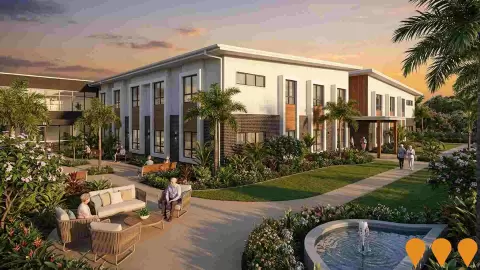
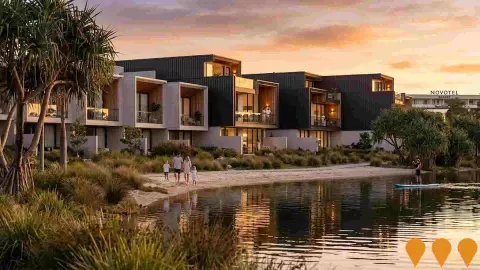
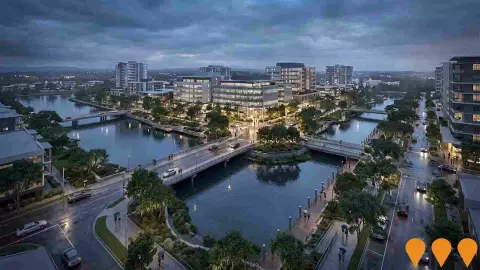
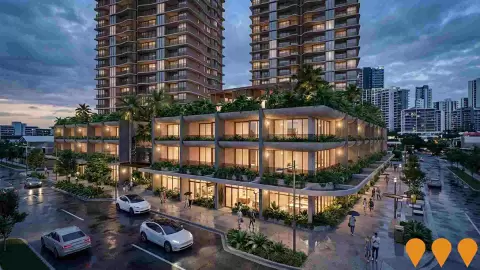
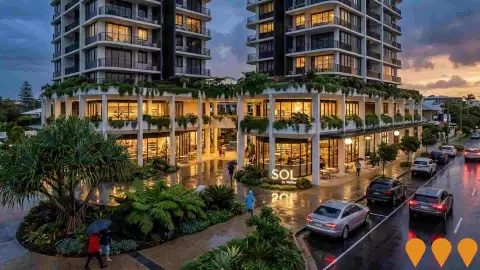
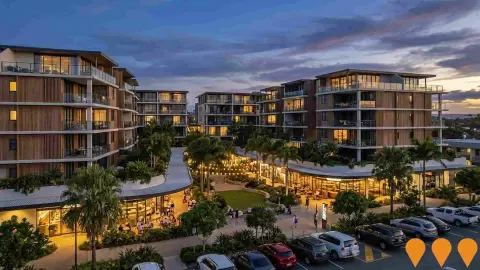
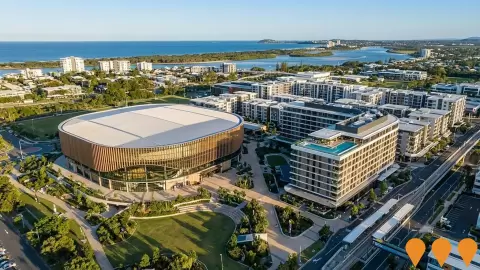
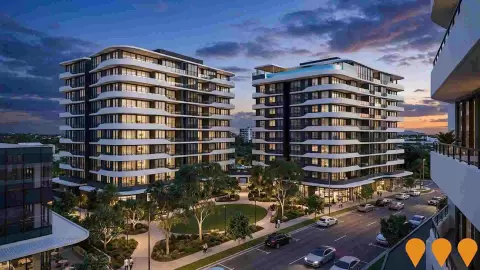
Denotes AI-based impression for illustrative purposes only, not to be taken as definitive under any circumstances. Please follow links and conduct other investigations from the project's source for actual imagery. Developers and project owners wishing us to use original imagery please Contact Us and we will do so.
Frequently Asked Questions - Infrastructure
Sunshine Coast Infrastructure Coordination Plan
A collaborative plan between the Queensland Government and Sunshine Coast Council to coordinate infrastructure for the Sunshine Coast Urban Corridor (Maroochydore to Caloundra). It outlines network constraints, planned network requirements, and co-location opportunities across various infrastructure classes (transport, energy, water, education, health, and social) to support significant population and employment growth up to 2041 and beyond. It is a priority action of the State Infrastructure Strategy.
Sunshine Coast Airport Expansion Project
Major airport expansion completed in June 2020 featuring a new 2,450m x 45m international runway (13/31) capable of handling wide-body aircraft including A330, B777, B787, and A350. The $347 million project enables direct international flights to Asia, China, and Hawaii, with new air traffic control tower and terminal upgrades. Declared a Priority Development Area in 2023, supporting ongoing terminal expansion, a 50-hectare aerospace precinct, and up to $1 billion in future infrastructure investments planned through 2040.
Proposed Sunshine Coast Planning Scheme
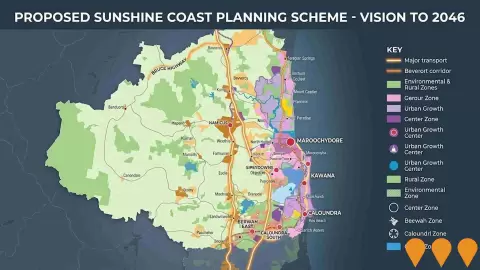
A comprehensive new Sunshine Coast Planning Scheme by Sunshine Coast Council to replace the 2014 scheme. It sets the planning vision for the region to 2046 (detailed planning to 2041), guiding sustainable growth, housing diversity and affordability, climate resilience, environmental protection, character maintenance, transport, and meeting regional growth targets. Includes 18 local plan areas (e.g., Buderim and Surrounds with constrained escarpment land and limited growth opportunities primarily along Wises Road/North Buderim Boulevard and parts of Forest Glen). Public consultation ran from 15 July to 19 September 2025 and is now closed; Council is currently reviewing submissions to determine required changes and whether to proceed with adoption.
Bruce Highway Upgrade - Maroochydore Road to Mons Road
Major upgrade of Bruce Highway interchange at Maroochydore Road and Mons Road, including new four-lane eastbound bridge, signalised interchange, service roads, and extension of Owen Creek Road. Project includes asphalt rehabilitation at Bli Bli interchange.
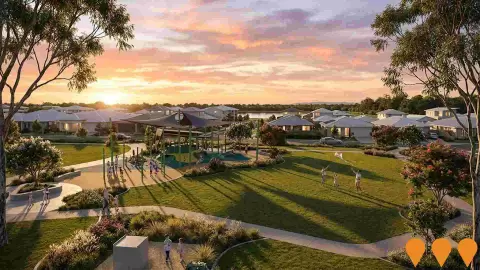
Stockland Twin Waters West
Approved masterplanned residential community on a 104 hectare site between the Maroochy River and the Sunshine Motorway. Council granted preliminary approval in December 2023. Site establishment works and trial embankments commenced in mid 2025. The plan includes about 450 detached homes with minimum lot size of 500sqm and average 700sqm, 1ha of community facilities, around 30.9ha of open space with three parks, and a new lake of about 17ha with a walkable waterfront network. Kangaroo habitat and central wetland protection are included.
Vantage Pacific Paradise
An established resort-style land lease community for over 50s operated as Vantage by AVID. Residents own their home and lease the land, with access to a clubhouse, heated pool and spa, gym, indoor bowls, tennis and pickleball, cinema, library, workshop, golf simulator and more inside a secure gated estate. Previously known as Living Gems Pacific Paradise.
New Sunshine Coast Planning Scheme (North Shore Local Plan)
The Sunshine Coast Council is developing a new planning scheme to replace the 2014 scheme. The North Shore Local Plan, which covers Twin Waters, Mudjimba, Pacific Paradise, and Marcoola, is a key component. The plan aims to guide future development while protecting the area's coastal character, environmental features, and managing constraints like airport operations. The directions propose minimal changes to building heights and urban growth boundaries in Twin Waters, retaining its suburban character.
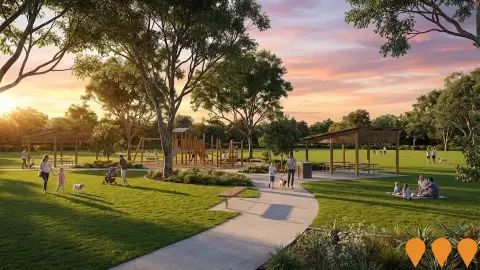
Wilkins Park, Pacific Paradise Improvements
Sunshine Coast Council is developing a concept plan for future improvements to Wilkins Park, a local park in Pacific Paradise. The plan aims to create a welcoming and enjoyable space for play, recreation, community gathering, and enjoying nature, based on community input. No funding is currently allocated for construction.
Employment
AreaSearch analysis reveals Twin Waters significantly outperforming the majority of regions assessed nationwide
Twin Waters has an educated workforce with significant professional services representation. Its unemployment rate in June 2025 was 1.7%.
This rate is 2.2% below Rest of Qld's rate of 3.9%, but workforce participation lags at 42.9% compared to Rest of Qld's 59.1%. Dominant employment sectors include health care & social assistance, education & training, and retail trade. The area shows strong specialization in professional & technical services with an employment share 1.9 times the regional level. Agriculture, forestry & fishing has limited presence at 0.5% compared to 4.5% regionally.
Employment opportunities appear limited locally, as indicated by Census working population vs resident population comparison. Between Jun-24 and Jul-25, labour force decreased by 2.8%, employment declined by 2.3%, causing unemployment to fall by 0.5 percentage points. By contrast, Rest of Qld recorded employment growth of 1.8% and labour force growth of 2.0%, with unemployment rising 0.2 percentage points. Jobs and Skills Australia's Sep-22 national employment forecasts project a 6.6% expansion over five years and 13.7% over ten years. Applying these projections to Twin Waters' employment mix suggests local employment should increase by 7.0% over five years and 14.3% over ten years, assuming constant population projections.
Frequently Asked Questions - Employment
Income
Income levels sit below national averages according to AreaSearch assessment
Twin Waters' income level is approximately average nationally according to latest ATO data aggregated by AreaSearch for financial year 2022. Twin Waters' median income among taxpayers is $48,774 and the average income stands at $64,890. This compares to figures for Rest of Qld's of $50,780 and $64,844 respectively. Based on Wage Price Index growth of 13.99% since financial year 2022, current estimates would be approximately $55,597 (median) and $73,968 (average) as of September 2025. Census 2021 income data shows household, family and personal incomes all rank modestly in Twin Waters, between the 44th and 46th percentiles. The data shows 29.7% of the population (933 individuals) fall within the $1,500 - 2,999 income range, reflecting patterns seen in the region where 31.7% similarly occupy this range. After housing, 86.5% of income remains for other expenses and the area's SEIFA income ranking places it in the 8th decile.
Frequently Asked Questions - Income
Housing
Twin Waters is characterized by a predominantly suburban housing profile, with above-average rates of outright home ownership
Twin Waters' dwelling structures, as per the latest Census, consisted of 73.9% houses and 26.1% other dwellings (semi-detached, apartments, 'other' dwellings), compared to Non-Metro Qld's 51.7% houses and 48.3% other dwellings. Home ownership in Twin Waters was at 58.0%, with mortgaged dwellings at 30.0% and rented ones at 12.0%. The median monthly mortgage repayment in the area was $2,167, higher than Non-Metro Qld's average of $1,820. The median weekly rent figure in Twin Waters was recorded at $650, compared to Non-Metro Qld's $420. Nationally, Twin Waters' mortgage repayments were significantly higher than the Australian average of $1,863, while rents were substantially above the national figure of $375.
Frequently Asked Questions - Housing
Household Composition
Twin Waters features high concentrations of family households, with a higher-than-average median household size
Family households constitute 80.3% of all households, including 19.2% couples with children, 55.2% couples without children, and 5.5% single parent families. Non-family households account for the remaining 19.7%, with lone person households at 18.0% and group households comprising 1.5%. The median household size is 2.3 people, larger than the Rest of Qld average of 2.2.
Frequently Asked Questions - Households
Local Schools & Education
Twin Waters shows strong educational performance, ranking in the upper quartile nationally when assessed across multiple qualification and achievement indicators
The area's university qualification rate of 29.5% among residents aged 15+ exceeds the Rest of Qld average of 20.6%, as well as the SA4 region's rate of 24.9%. Bachelor degrees are most common at 20.3%, followed by postgraduate qualifications (5.9%) and graduate diplomas (3.3%). Vocational credentials are held by 35.2% of residents aged 15+, with advanced diplomas at 13.4% and certificates at 21.8%.
A total of 20.1% of the population is actively pursuing formal education, including 6.7% in secondary, 5.5% in primary, and 4.0% in tertiary education. Educational facilities appear to be located outside immediate catchment boundaries, requiring families to access schools in neighboring areas.
Frequently Asked Questions - Education
Schools Detail
Nearby Services & Amenities
Transport
No public transport data available for this catchment area.
Frequently Asked Questions - Transport
Transport Stops Detail
Health
Health performance in Twin Waters is well below average with prevalence of common health conditions notable across both younger and older age cohorts
Twin Waters faces significant health challenges, with common conditions prevalent across both younger and older age groups.
Private health cover stands at approximately 53%, covering about 1,663 people, which is higher than the average SA2 area. The most frequent medical conditions are arthritis (affecting 13.0% of residents) and heart disease (6.7%). Notably, 62.4% of residents report no medical ailments, compared to 67.2% in Rest of Qld. Twin Waters has a higher proportion of seniors aged 65 and over, at 42.9% or 1,348 people, compared to the state average of 24.4%. Despite this, health outcomes among seniors are strong and outperform the general population's health metrics.
Frequently Asked Questions - Health
Cultural Diversity
In terms of cultural diversity, Twin Waters records figures broadly comparable to the national average, as found in AreaSearch's assessment of a number of language and cultural background related metrics
Twin Waters' cultural diversity aligns with the broader regional average, with 72.3% born in Australia, 87.7% being citizens, and 94.0% speaking English only at home. Christianity is the predominant religion at 60.3%. Judaism, though small at 0.4%, is higher than the Rest of Qld's 0.1%.
The top three ancestral groups are English (37.0%), Australian (21.9%), and Scottish (9.7%). French (0.9%) Welsh (0.8%), and German (6.1%) show notable increases compared to regional averages of 0.7%, 0.6%, and 4.8% respectively.
Frequently Asked Questions - Diversity
Age
Twin Waters ranks among the oldest 10% of areas nationwide
Twin Waters has a median age of 60, which is significantly higher than the Rest of Qld figure of 41 and Australia's median age of 38. The 65-74 age group constitutes 22.7% of Twin Waters' population, compared to Rest of Qld's percentage, while the 25-34 cohort makes up only 5.5%. This concentration in the 65-74 age group is well above the national average of 9.4%. Between 2021 and present, the 25-34 age group has grown from 4.0% to 5.5%, while the 75-84 cohort increased from 14.1% to 15.4%. Conversely, the 55-64 cohort declined from 18.8% to 17.1%, and the 45-54 group dropped from 11.3% to 9.8%. By 2041, demographic modeling suggests Twin Waters' age profile will evolve significantly. Leading this shift, the 85+ group is projected to grow by 92%, reaching 290 people from 150. This growth is driven by residents aged 65 and older, who represent 81% of anticipated population increase. Meanwhile, both the 5-14 and 45-54 age groups are expected to decrease in numbers.