Building approvals, live development applications and major projects across the
Central Highlands (Tas.) statistical area — covering Southern Midlands, Derwent Valley and Central Highlands and 2 more.
SA3 60301Rest of Tas.13,043 residents3 statistical areas
The PipelineDevelopment Pipeline in Central Highlands (Tas.)
1 ProposedNot yet coveredcouncil planning feeds for this area are still being addedCoverage expanding
2 Approved56dwellings approved in 2025-26, or 0.43 per 100 existing dwellings a yearOfficial · ABS to August 2026See approvals ↓
3 Building7major projects committed or under construction, 1 of them already on siteForward · completions to 2030+See projects ↓
4 Delivered529new addresses verified since the 2021 Census, up 6.4% on the existing baseActual · to August 2026Where it landed ↓
In the 2025-26 financial year the ABS recorded 56 dwelling approvals across Central Highlands (Tas.). AreaSearch tracks 7 major projects here that are committed or under construction, the largest being Cellars Hill Wind Farm at an estimated $1.50bn. On the ground, 529 new addresses have been verified since the 2021 Census — growth of 6.4% on the existing address base.
These four figures are deliberately not added together. An application, an
approval and a project under construction are often the same building at three points in its life,
measured by three different bodies with three different lags. Read them as a sequence, not a total.
ApprovedBuilding Approvals in Central Highlands (Tas.)
What councils and certifiers have formally
permitted — the ABS series, published about four months in arrears.
Approvals are running at 0.43 per 100 existing dwellings a year, in line with the Tasmania rate of 0.43. Development here remains overwhelmingly detached: houses account for 100% of recent approvals. The mix being approved closely matches what is already standing — 99% houses against 98% of existing homes. The average approved dwelling is valued at $358,000 in construction cost.
For its size, Central Highlands (Tas.) is adding 0.43 dwellings a year per 100 existing homes — in line with the Tasmania rate of 0.43 and the national rate of 0.71. That is about 4.7 approvals a year for every 1,000 residents. Building intensity has been broadly stable across the published series.
Measured against people rather than housing stock, Central Highlands (Tas.) is approving 4.32 dwellings a year per 1,000 residents — in line with the Tasmania rate of 4.65. The two rate views differ by household size, which here averages 2.7 people per home.
Dwelling approvals a year per 100 existing
homes, with Tasmania and Australia for comparison. This is the
same activity as the totals view, divided by the size of the area — which is the only
fair way to compare a large SA3 with a small one.
Dwelling approvals a year per 1,000
residents, each year divided by that year’s estimated resident
population (ABS ERP at 30 June), not by today’s — which matters most in fast-growing
areas, where a fixed denominator can understate the early years by half. The most recent periods use the latest published ERP, as the population series runs a year behind approvals. Read it alongside the per-100-homes view: the two differ wherever household size does.
Dwelling units approved each financial year. The dashed line is the five-year average of 61.
How intensively is it building?
Dwelling approvals a year per 100 existing dwellings.
Central Highlands (Tas.)0.43
Tasmania0.43
Australia0.71
What is here, and what is coming
Detached houses as a share of existing homes,
against the share of recent approvals.
Existing homes (2021 Census)98%
Approved, last 5 years99%
Approved, latest year100%
Detached housesApartments, townhouses & other
Approvals mix by year
Share of each year’s approvals.
2023
2024
2025
2026
2025-26
$26.1m
Residential work approved
2025-26
$55.5m
Commercial work approved
construction cost
$358,000
Average value per approved dwelling
last two years
231
Residents per approval
Supply & DemandIs Central Highlands (Tas.) Building Enough Homes?
The same approvals, measured against the population
they have to house.
Central Highlands (Tas.) approves about 4.7 new dwellings a year for every 1,000 residents. Since the 2021 Census it has added 603 residents and 529 new addresses — about 1.1 extra people per home built, below the 2.7-person average household, so building has run ahead of population growth.
Growth against supply since the Census
People added for every new address verified,
against the size of an average local household.
People added per new home1.1
Average household size2.7
A bar longer than the household average means
the area gained more residents than its new housing could hold, and the extra had to be
absorbed by existing homes.
Approval rate against projected need
Dwellings a year: what is currently being
approved, against what the 2041 population projection implies.
4.7
dwellings approved a year per 1,000 residents.
No population projection is published for this area.
BuildingFORWARDMajor Projects & Infrastructure in Central Highlands (Tas.)
What is funded and moving — the projects large enough
to change how Central Highlands (Tas.) works, ranked by committed value and how close
they are to delivery.
AreaSearch tracks 7 current projects across Central Highlands (Tas.). The largest is Cellars Hill Wind Farm at an estimated $1.50bn, due by 2030. That breaks down as 1 under construction, 3 approved and awaiting a start and 3 still in planning. The pipeline is weighted toward energy, manufacturing and transport & logistics.
Approved$350mby 2027
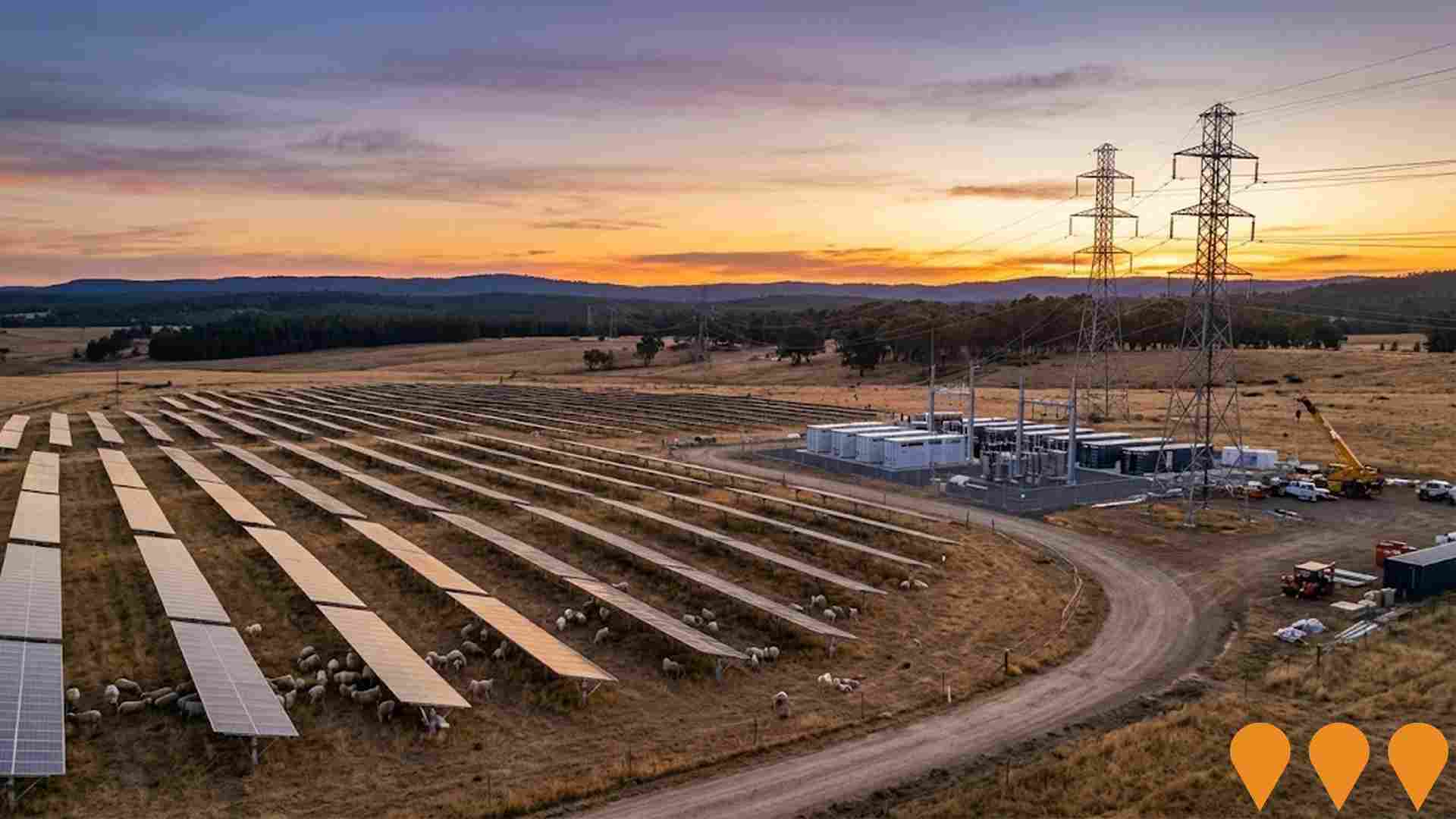
Weasel Solar Farm
Landowner-led renewable energy project comprising a 250 MW solar farm with a 144 MW / 576 MWh battery energy storage system on approximately 435 hectares about 9 km north of Bothwell. The project received…
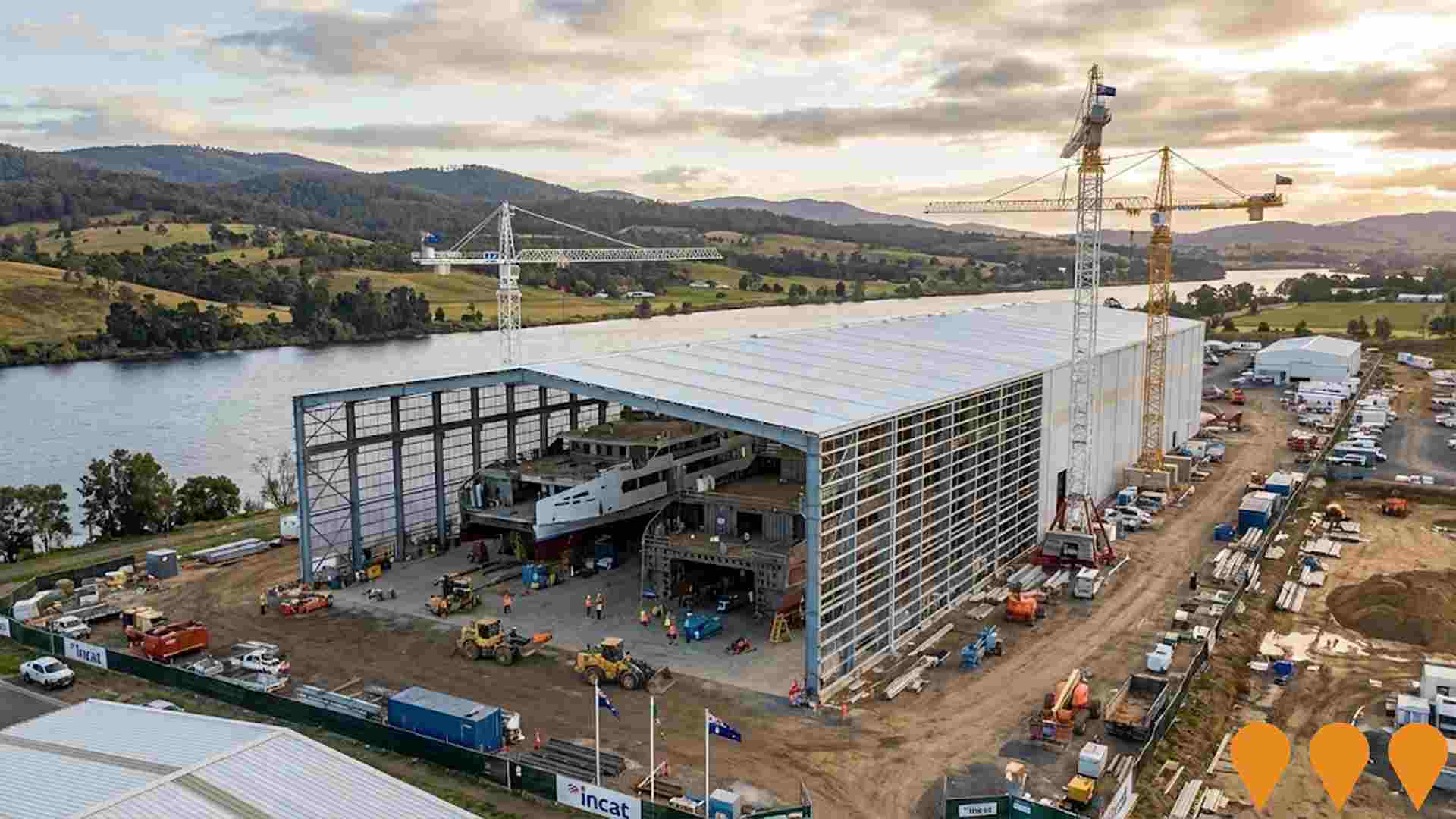
New 12-hectare shipbuilding facility at the Boyer Mill site for constructing hulls and decks for electric ferries. Features a 240x120m production facility capable of constructing three large vessels…
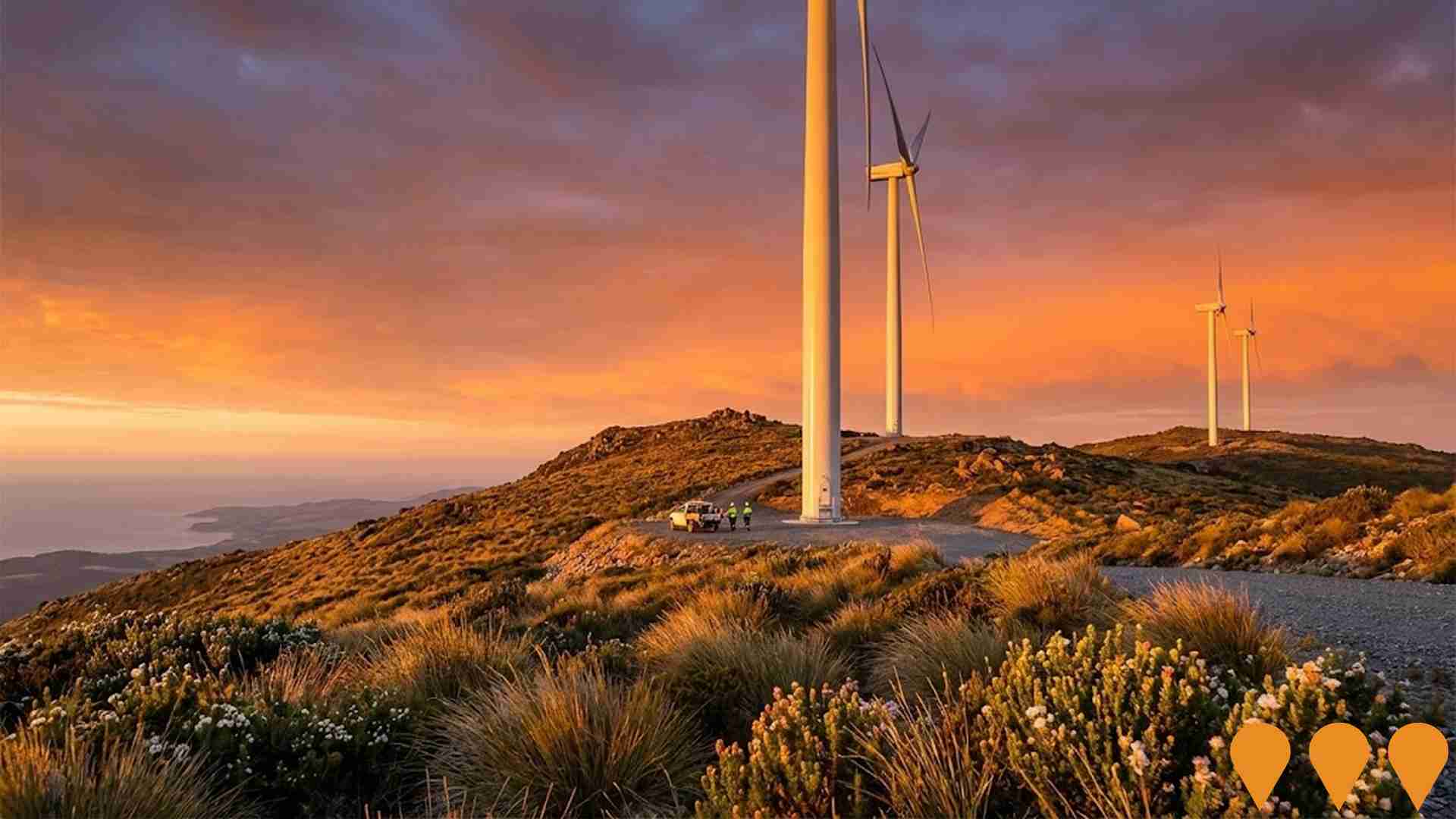
A proposed 350 MW wind farm with up to 56 turbines and an accompanying 600 MW / 2400 MWh battery energy storage system, located in Tasmania's Central Highlands approximately 10 km northwest of Bothwell…
Tarraleah Power Station RedevelopmentIn planning · Energy · Central Highlands
Burnie To Hobart Freight Corridor ImprovementIn planning · Transport & Logistics · Central Highlands
Denotes AI-based impression for illustrative purposes only, not to be taken as
definitive under any circumstances. Please follow links and conduct other
investigations from the project’s source for actual imagery. Developers and
project owners wishing us to use original imagery please Contact
Us and we will do so.
Estimated value of tracked projects by the year they are due to
complete, stacked by how certain they are. The dark band is money already being spent;
the pale band is still an intention. Estimates are indicative and mix infrastructure
cost with whole-of-precinct development value, so read the shape rather than the totals.
ProfessionalPRODevelopment Map for Central Highlands (Tas.)
Applications and major projects plotted where
they are actually proposed, with the
7 projects AreaSearch tracks here on their own tab — filterable by type, delivery stage,
area and committed value. To search every application on record rather
than this sample, use the section above.
DistributionWhere Development Is Happening in Central Highlands (Tas.)
Central Highlands (Tas.) covers 3 statistical areas, and development is not spread evenly between them. Southern Midlands alone accounted for 79% of the area’s dwelling approvals in 2025-26.
Approvals per 100 existing homes in
2025-26, by statistical area, with the Central Highlands (Tas.) figure marked. Ranked
rather than stacked: rates cannot be added together.
Approvals per 1,000 residents in 2025-26,
by statistical area, against each area’s own estimated resident population, with the
Central Highlands (Tas.) figure marked. A small area building hard is invisible in
the totals view and obvious here.
Dwelling approvals each financial year, split by the statistical area they
fell in. Each column totals the whole Central Highlands (Tas.) figure from the
approvals chart above — SA2s nest exactly inside an SA3, so the two always reconcile.
Tap or click an area in the legend to hide it and compare the rest.
Map builder
Each area below opens a map builder on its own page — a tool for
putting a map and a table into a report. Pick the place types you want plotted
(schools, supermarkets, medical, child care, transport and the rest of what
AreaSearch holds), add development applications as their own layer, drop your own
points, then recolour, renumber and export the result as a table or CSV.
A this area only toggle clips everything to the boundary you are looking at.
Searches are charged against your credit balance — 1 credit per 40
results from AreaSearch data — and setting filters costs nothing until
you search. The builder works on one suburb-sized area at a time, which is why it
opens per area rather than across the whole of
Central Highlands (Tas.).
Planning AuthoritiesCouncils Covering Central Highlands (Tas.)
Central Highlands (Tas.) spans 5 local government areas — Southern Midlands, Derwent Valley, Central Highlands, Glamorgan-Spring Bay and Huon Valley. Applications here are assessed by whichever of those councils the site falls within. AreaSearch publishes development
figures at ABS statistical boundaries rather than council boundaries. That is deliberate: the ABS
issues a separate official building-approvals series for local government areas, and totals
built up from statistical areas would not match it. Reporting at SA3 keeps every figure on this page
reconcilable with the published ABS series.
Local government area
Share of Central Highlands (Tas.)
Applications on record
Register read to
Southern Midlands
53% of residents
—
Not yet collected
Derwent Valley
26% of residents
—
Not yet collected
Central Highlands
20% of residents
—
Not yet collected
Glamorgan-Spring Bay
0.1% of residents
—
Not yet collected
Huon Valley
0.0% of residents
—
Not yet collected
CompareNearby Development Hubs
The same view of building approvals, applications and
major projects for areas neighbouring Central Highlands (Tas.).
Data & MethodSources & Method for Central Highlands (Tas.)
The four tenses, and what each one can tell you
Proposed — development applications
Collected from council planning portals. The
earliest signal available, but the least certain: many applications are amended,
withdrawn or refused, values are the applicant’s own estimate, and coverage
varies by council. This is a curated set, not the full council feed:
AreaSearch carries applications of material scale and does not track routine minor
works such as signage, fencing or small alterations, so the counts here are lower
than a council’s own total lodgement figure and should not be compared with it. Applications still shown as under assessment more than
18 months after lodgement are reported separately
and kept out of the live-queue figures: the age profile of open applications is
sharply split between a genuine queue under a year old and a long tail of records
councils never closed. Not every state publishes a cost of works — Queensland,
the Northern Territory and the ACT publish none at all — so on those pages
applications are counted rather than valued and no dollar figure is shown
rather than a partial one. Treated here as a snapshot of the current queue only —
AreaSearch does not chart application counts over time, because the history
reflects when each portal was collected rather than when development happened.
Approved — ABS building approvals
The official series, aggregated to SA3 from
ABS building approvals data, currently published to August 2026.
Counts dwelling units approved, not buildings and not completions. The most recent
financial year is annualised from nine months of data wherever it appears and is
labelled as such.
Building — major projects
Projects tracked individually by AreaSearch
from Infrastructure Australia, state infrastructure agencies, developer disclosures
and council records. Values are estimates and delivery dates are targets. Ranked on
this page by committed value and delivery stage rather than by distance.
Delivered — verified new addresses
New residential addresses verified in the national
address register since the 2021 Census. This is the closest available measure of what has
actually been built, though address creation can lead occupation and lags
construction. It is not a completions count.
Boundaries
Central Highlands (Tas.) is Statistical Area Level 3 60301 in the ABS Australian Statistical Geography Standard (2021 edition), made up of 3 Statistical Areas Level 2.
It has an estimated 13,043 residents, +4.9% since the 2021 Census.
Currency
Measure
Source
To
Dwelling approvals, five-year average
ABS / AreaSearch
August 2026
House share of approvals
ABS / AreaSearch
August 2026
Residents per approval
ABS / AreaSearch
August 2026
Value per approved dwelling
ABS / AreaSearch
August 2026
Commercial work approved
ABS / AreaSearch
August 2026
Verified new addresses since the Census
Address register / AreaSearch
August 2026
Major projects
Infrastructure Australia / state agencies / AreaSearch
Ongoing
Figures on this page are read live from the
AreaSearch database each time it loads, so they update as soon as a source does.
Development in Central Highlands (Tas.) — common questions
How many new dwellings were approved in Central Highlands (Tas.)?
The ABS recorded 56 dwelling approvals across Central Highlands (Tas.) in the 2025-26 financial year, against a five-year average of 61 a year.
What major projects are planned for Central Highlands (Tas.)?
AreaSearch tracks 7 current major projects in Central Highlands (Tas.), 1 of them under construction. The largest include Weasel Solar Farm, Incat Boyer Ferry Manufacturing Facility and Cellars Hill Wind Farm.
Which council covers Central Highlands (Tas.)?
Central Highlands (Tas.) is an ABS Statistical Area Level 3. It is covered by parts of 5 local government areas — Southern Midlands, Derwent Valley, Central Highlands, Glamorgan-Spring Bay and Huon Valley. AreaSearch publishes development figures at ABS statistical boundaries rather than council boundaries, so they reconcile with the official ABS series.
Is Central Highlands (Tas.) growing faster than the rest of Tasmania?
On development approvals, Central Highlands (Tas.) is adding new dwellings at about the same rate as Tasmania as a whole — 0.43 approvals per 100 existing dwellings a year against the state figure of 0.43.
How current is this development data?
ABS building approvals are published with a lag of roughly four months; this page carries the series to August 2026. Development applications are collected from council planning portals and refresh continuously. Major project records are reviewed on an ongoing basis. Each section carries its own currency label so the four are never confused.
Development data is provided for general information.
Estimated values, dwelling counts and delivery dates come from the lodging or delivering party and
are not independently verified by AreaSearch. Confirm anything material with the relevant council
or agency before relying on it.